
Is the 316 Upgrade Worth It?
The Cost Model Behind a Material Decision

Table of Contents
- 1. Why This Is a Costing Decision, Not a Metallurgy Lesson
- 2. What the Upgrade Actually Buys You: 304 vs 316 vs 316L
- 3. Where 316 Earns Its Premium: Four Real Failure Modes
- 4. The Cost Model: Does the Premium Pay Back?
- 5. Decision Framework: Four Questions Before You Specify 316
- 6. What “Medical-Grade” and “Marine-Grade” Really Mean
- 7. Verifying You Received 316 — Not Mislabeled 304
- 8. Compliance Documentation by Market
- 9. Buyer Questions We Are Asked Most Often
- 10. Partner With Mofecup on Your Material Specification
1. Why This Is a Costing Decision, Not a Metallurgy Lesson
Turn a stainless steel mug upside down and you will usually find a small laser mark: 304 or 316. To the person holding it, it reads as a factory code. In a sourcing conversation, it is the single line on the specification that most often turns into a debate — because one grade costs meaningfully more than the other, and the mug looks identical either way.
The usual framing of this question is metallurgical: nickel, chromium, molybdenum, crystal structure. That framing is accurate and it is also not much help when you are sitting in front of a quotation and a launch date. The real question is a costing question:
Does the premium I pay now cost me less than the failures I avoid later?
This article works that question as a calculation you can run on your own numbers. It is deliberately not a repeat of the grade chemistry — if you want the composition tables, corrosion mechanisms and laboratory verification methods side by side for all three common grades, that is covered in our technical comparison of 201, 304 and 316 stainless steel. Here we stay on the buying decision.
Two articles, two jobs
Need the materials science? Composition, corrosion mechanisms, salt-spray and XRF verification → Stainless Steel Grades 201 vs 304 vs 316.
Need the buying decision? Whether the premium pays back, and under what conditions → this article.
2. What the Upgrade Actually Buys You: 304 vs 316 vs 316L
“Stainless steel” is a category, not a substance. The grades used in drinkware are defined by alloy composition, and the composition is what determines how the metal behaves once a customer fills the mug with something acidic[1]. Three designations matter in practice.
| Property | 304 | 316 | 316L |
|---|---|---|---|
| Chromium | 18–20% | 16–18% | 16–18% |
| Nickel | 8–10.5% | 10–14% | 10–14% |
| Molybdenum | — | 2–3% ✅ | 2–3% ✅ |
| Carbon | ≤ 0.07% | ≤ 0.08% | ≤ 0.03% (low carbon) ✅ |
| Chloride / acid resistance | Good for neutral and mildly acidic drinks | Superior — resists pitting in chloride and acid environments | Equivalent to 316, better after welding |
| Where it is the right default | Water, milk, neutral drinks; volume programmes | Tea, coffee, juice, cold brew; premium and gifting | Seam-welded or double-wall bodies where weld integrity matters |
The one element that changes everything: molybdenum
The step from 304 to 316 is not a uniform upgrade across every property. It is one targeted addition — roughly 2–3% molybdenum — and that addition does one important job: it substantially raises the metal’s resistance to localised pitting corrosion, particularly where chlorides and organic acids are involved. Chromium is what forms the passive oxide film that makes stainless steel “stainless” at all; molybdenum is what keeps that film intact when the environment attacks it in spots rather than uniformly.
316L is the same alloy with carbon held to a maximum of 0.03%. The lower carbon matters after welding: it reduces the risk of carbide precipitation at the weld seam, which is the mechanism behind weld-adjacent corrosion. If your mug is a double-wall vacuum body with visible weld geometry, the L variant is worth asking about — our article on copper-infused stainless steel compared with 304 and 316 covers how these variants behave in insulated constructions.
3. Where 316 Earns Its Premium: Four Real Failure Modes
The premium is only justified if it prevents something that would otherwise happen. In mugs, the something is one of four failure modes — and the fourth is the one that costs the most.
| Failure mode | Who notices | Cost when it happens | Does 316 prevent it? |
|---|---|---|---|
| Interior staining and “tea film” | End user, within weeks | Low direct cost, high perceived-quality cost | Largely, yes |
| Pitting corrosion (rust-coloured speckling) | End user, months in; intensified by salt and dishwasher detergent | Returns and negative reviews | Yes — this is the specific mechanism molybdenum addresses |
| Metallic taste in tea, coffee, citrus | End user, immediately | Perceived product defect; hard to argue against | Yes |
| Grade substitution discovered by the buyer | Your client, your retailer, or a compliance test | The expensive one: batch rejection, recall exposure, contractual breach | Not a property of the steel — a property of the supplier |
Note what the fourth row really says. Three of these failure modes are about the alloy. The fourth is about honesty in the supply chain — and switching from a 304 supplier to a 316 supplier does not fix it if the underlying problem is that nobody verified the material. That is why Section 7 exists in this article, and why the verification methods matter as much as the grade you select. For the adjacent question of what the metal can release into a drink, see our article on heavy metal leaching in ceramic and glass drinkware, and for the wider material comparison across stainless, glass and ceramic, our guide to drinkware materials by application.
4. The Cost Model: Does the Premium Pay Back?
This is the part most material guides skip, and it is the only part that decides the purchase. The arithmetic is simpler than it looks.
Step 1 — Establish the real premium per unit
The premium quoted is usually the material premium, commonly in the region of 15–25% above 304 on the steel itself. What matters for your business is the premium on the finished branded unit, and that number is always smaller — because finishing, decoration, lids, packaging and freight are largely identical for both grades.
Worked example, using illustrative figures only. If a 304 mug lands at a unit cost of 20 and the material premium pushes that to 22, the finished-unit premium is 2 — 10%, not 25%. Always ask your supplier for the uplift on the landed finished unit, and treat any figure you cannot break down as an estimate.
Step 2 — Put a number on a failure
A “return” is never just the unit cost. Add up everything a single failed mug costs you:
- Replacement unit and, if you ship one, the outbound freight
- Reverse logistics or a refund issued without return
- Support time — the emails, the photos, the escalation
- The review, which affects every future buyer who reads it
- For B2B and gifting programmes: the client relationship, which is usually the largest line of all
Step 3 — Find the break-even failure rate
Divide the per-unit premium by the cost of one failure. The result is the reduction in failure rate the upgrade has to deliver to pay for itself.
| Per-unit premium | Cost of one failure | Break-even reduction in failure rate | Read |
|---|---|---|---|
| 2 | 20 | 0.10 = 10 percentage points | Hard to justify — needs a very high failure rate to be true |
| 2 | 60 | 0.033 = 3.3 percentage points | Justifiable for acidic-drink use and premium positioning |
| 2 | 200 | 0.01 = 1 percentage point | Clearly justified — B2B, gifting, private label |
The table is not a recommendation; it is a demonstration of how the decision flips. The same upgrade is a poor buy for a low-cost giveaway and an obvious buy for a private-label programme where a single failure costs a client relationship. Which brings us to the honest summary of this whole question:
316 is not “better steel”. It is a premium you buy against a specific risk. If that risk is small in your programme, you are paying for nothing. If it is large, you are under-insured without it.
5. Decision Framework: Four Questions Before You Specify 316
Answer these four before the quotation, not after the samples arrive.
| Question | Answer pointing to 304 | Answer pointing to 316 |
|---|---|---|
| 1. What will actually be poured into it? | Water, milk, neutral drinks | Tea, coffee, citrus, cold brew, flavoured or carbonated drinks, electrolyte mixes |
| 2. How long must it stay presentable? | A campaign cycle — one quarter to one year | A product users keep and use daily for years |
| 3. What does one failure cost the relationship? | Low — a giveaway, a one-off event, an anonymous recipient | High — a B2B client, a retail account, an executive gift |
| 4. Who is the end user? | General adult users in general conditions | Children, elderly users, health-focused buyers, medical-adjacent or wellness brands — audiences where a safety margin is itself the selling point |
The pattern behind the four questions
Three or more right-hand answers means 316 is the economically correct specification, not a luxury. Two or fewer means the premium is buying insurance against a risk your programme does not carry — and the honest move is to put that budget into something the customer will notice, such as a better lid, a better finish or better packaging.
There is also a hybrid worth knowing about: use 316 for the interior where the drink contacts the metal, and a lower-grade or differently finished exterior where only the hand and the eye are involved. It is not always offered by default — ask, because in some constructions it captures most of the benefit at a fraction of the premium. For context on how material choices map onto specific end uses, see our guide to drinkware materials by application.
6. What “Medical-Grade” and “Marine-Grade” Really Mean
316 is frequently sold as “medical-grade” or “marine-grade” stainless steel. Both phrases circulate widely in drinkware marketing, and both are loose enough to be misleading in a specification conversation. Since your packaging may end up repeating them, it is worth being precise about what they actually refer to.
| Term | What it loosely signals | What it is not |
|---|---|---|
| “Medical-grade” | Hints at high corrosion resistance and cleanability, in the spirit of alloys used in clinical settings | A certification. Implant and surgical applications use dedicated alloy standards and their own low-carbon variants — a drinkware mug is not tested to them, and a “medical-grade” coffee mug is a marketing phrase rather than a verified status. |
| “Marine-grade” | Points to molybdenum’s resistance to chloride attack — genuinely relevant to salt exposure | A defined grade. Marine environments often call for higher-alloy families than 316, and no standard body issues a “marine grade” certificate. |
| “Food-grade” | The useful one — it corresponds to actual regulatory frameworks and testable limits[2] | Nothing — this is the term to standardise on. It can be documented per market, which the other two cannot. |
The practical rule: market the properties, not the labels. “Molybdenum-bearing alloy for resistance to acidic drinks” is a claim you can support. “Medical-grade” is a claim a compliance-minded retail buyer may ask you to substantiate — and it is not substantiable as written. For the certification language that is worth putting on packaging, see our guide to food-grade certification standards for drinkware.
7. Verifying You Received 316 — Not Mislabeled 304
This is the gap that makes the whole premium question moot if it is left open. You cannot tell 304 from 316 by looking at it, weighing it, or reading the laser mark — and grade substitution, where 201 or 304 is supplied against a 316 order, is a well-known problem in the category rather than a theoretical one.
Three checks cover the majority of the exposure. The detail on each — instrument settings, certificate interpretation and the salt-spray schedule — is in our grade comparison and verification guide; what follows is the buyer-side summary.
- Require a material test certificate per shipment, not per order. Certificates correspond to the steel batch. A certificate attached to your first order tells you nothing about the fifth.
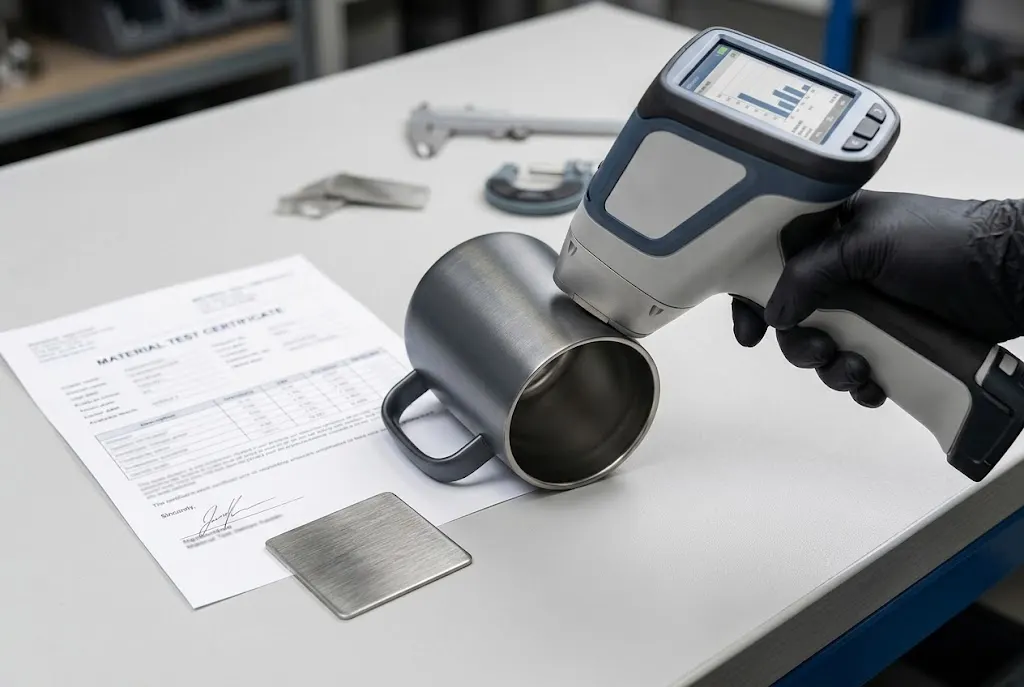
- Ask for XRF composition reading. Handheld X-ray fluorescence gives an immediate chromium, nickel and molybdenum reading. Molybdenum is the discriminator — its presence is what separates 316 from 304, and its absence is unambiguous.
- Run a corrosion check on a production sample. An accelerated salt-spray exposure will pit a substituted 304 that would survive as 316. This is the slowest check and the most conclusive.
Two structural points that buyers regularly miss. First, “316” at the material stage does not certify the finished mug: welding, polishing and coating all sit between the steel coil and the product you receive, and they can undo material performance. On the compliance side, the migration testing that applies to the finished article is covered in our guide to food-contact migration testing. Second, if your product carries a no-metal-taste or material safety promise, the verification should extend beyond the metal to the seals, gaskets and any interior coating — a mug can have perfect steel and still fail on a plastic component. Our notes on material choice as the safety line and on stainless steel safety for drinking cover where the risk actually sits.
8. Compliance Documentation by Market
Whichever grade you choose, the paperwork obligation is set by where you sell, not by the grade. The table below is the short version; match it against your destination markets before the design is locked.
| Market | Framework | What to request |
|---|---|---|
| United States | FDA food-contact framework for food-contact substances[4]; coatings and adhesives regulated as indirect food additives[5]; polymer components such as lids and gaskets under their own part[6] | Composition statement for the metal plus a declaration covering any interior coating, seal and gasket in the assembly |
| European Union | Regulation (EC) No 1935/2004 — framework for materials intended to come into contact with food[7] | Declaration of compliance naming the substances used and the migration testing behind the claim |
| China (and as a factory baseline) | GB 4806.9 — national food safety standard for metal materials and products in contact with food[2]; GB/T 29606 for stainless steel drinkware construction and thermal performance[3] | Test reports citing these standards — most China-based programmes are built against them, so their absence is a signal |
| All markets | Material composition and grade tolerances | A certificate referencing the applicable material specification, tracing to the batch supplied[1] |
One note on scope, because it is where budgets go astray: compliance is a property of the assembly, not the steel. A mug with 316 walls, a coated interior finish and a silicone gasket has three material categories in it, and each may need its own documentation depending on the market. Ask for the full bill of materials against your destination markets rather than a single steel certificate.
9. Buyer Questions We Are Asked Most Often
Does 316 change the taste of a drink?
It does not add a taste. What it does is reduce the likelihood of the metal contributing an off-taste later — which is a different and more useful statement than the marketing version. The relevant mechanism is surface degradation: where pitting or film buildup begins, taste perception follows. Keep the passive surface intact and the drink tastes like the drink.
Is 316 safer than 304?
Both are accepted food-contact materials when correctly specified and produced. 316 is not “safer” in the sense of passing a bar that 304 fails; it carries a wider margin under aggressive conditions and over long service life. If your compliance testing is identical for both grades, the difference is durability, not admissibility.
Will anyone notice the upgrade?
Not visually — and that is precisely the point. The upgrade is not a selling feature on the shelf; it is a reduction in the probability of a complaint. If your marketing needs a visible differentiator, that is a separate investment, and materials are usually not the right place to spend it. Our article on ceramic mug printing techniques covers the decoration levers customers do see.
Should I use 316 for the whole mug or only the interior?
Interior-only is a legitimate and often sensible specification: the corrosion risk is where the drink sits. Exterior grade affects appearance durability more than food safety. Ask what the cost difference is in your specific construction — the answer depends on the wall build, and it is not always offered as an option unless you request it.
Does the decoration affect any of this?
Decoration acts on the exterior and does not change the alloy’s corrosion behaviour. It does, however, add its own compliance layer — coatings and inks are regulated separately from the base metal[5]. For the food-safety side of powder coating and other finishes, see our article on material choice as the safety line. And because steel drinkware needs to be maintained to stay in condition, our cleaning and care guide is worth passing to end users.
Still deciding between 304 and 316 for your mug programme?Send us your end-use scenario, target market and annual volume, and Mofecup will quote both grades side by side on the landed finished unit — including the composition documentation our production partners hold. We will also tell you when 304 is the correct answer, because an over-specified programme is a programme the client second-guesses. Request a quote →
10. Partner With Mofecup on Your Material Specification
Mofecup is a drinkware supplier, not a steel mill — and we are deliberate about that distinction. Our role is to define the correct material standard for your use case, match it to qualified production partners, and hold that standard consistently across the batch.
What that means in practice for a mug programme:
- Material specification first. We define grade, wall construction and interior finish against your end use — not against a price target.
- Composition verification. Alloy composition is checked so that a 316 specification is genuinely 316, rather than a mislabelled 304 — the substitution risk described in Section 7.
- 316L on request where weld integrity matters more than raw corrosion resistance, such as seam-welded or complex double-wall constructions.
- Surface finishing standards that support cleanability and taste neutrality over the product’s life — see materials by application.
- Both grades quoted side by side on the landed finished unit, so the premium decision is made on real numbers rather than on a percentage quoted for the raw material.
- Compliance documentation per market, covering the full assembly — metal, coating, seal and gasket.
- Decoration that supports the positioning, from laser engraving to ceramic-print quality finishes; for mugs specifically, see our printing techniques comparison and for first-merchandise programmes our notes on mugs for new coffee brands.
Start with the technical ground on 201, 304 and 316 stainless steel, or send us your brief and we will come back with both grades priced and specified for comparison.
Footnotes & References
[1] ASTM International. ASTM A240/A240M — Standard Specification for Chromium and Chromium-Nickel Stainless Steel Plate, Sheet, and Strip for Pressure Vessels and for General Applications (source of the type 304, 316 and 316L composition ranges quoted in Section 2). astm.org
[2] National Health Commission of the People’s Republic of China. GB 4806.9 — National food safety standard: Metal materials and products for food contact (食品安全国家标准 · 食品接触用金属材料及制品). Current edition GB 4806.9-2023. chinesestandard.net
[3] Standardization Administration of China. GB/T 29606 — Stainless steel vacuum cups (不锈钢真空杯). Current edition GB/T 29606-2013; revised edition GB/T 29606-2026 published January 2026 for implementation February 2027. openstd.samr.gov.cn
[4] U.S. Food & Drug Administration. Packaging & Food Contact Substances (FCS) — regulatory framework for substances used in materials that contact food. fda.gov
[5] U.S. Electronic Code of Federal Regulations. 21 CFR Part 175 — Indirect Food Additives: Adhesives and Components of Coatings. ecfr.gov
[6] U.S. Electronic Code of Federal Regulations. 21 CFR Part 177 — Indirect Food Additives: Polymers (applies to plastic components such as lids, seals and gaskets). ecfr.gov
[7] European Parliament and Council. Regulation (EC) No 1935/2004 on materials and articles intended to come into contact with food. eur-lex.europa.eu