The Safest Stainless Steel For Your Drinks
201 vs. 304 vs. 316 Stainless Steel
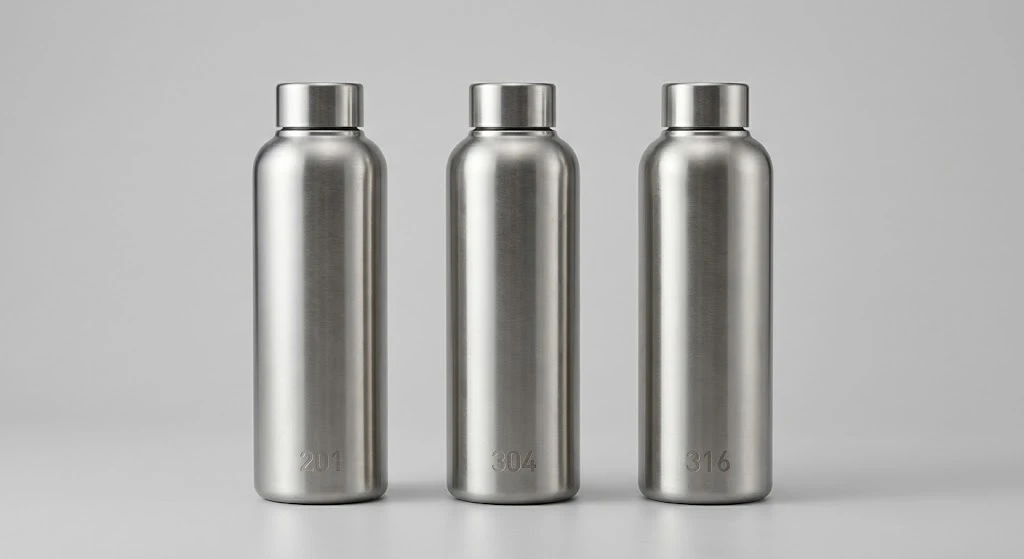
Table of Contents
- 1. Stainless Steel Grades Explained: 201, 304, 316
- 2. Side-by-Side Comparison: Composition, Resistance & Cost
- 3. Why Grade Choice Matters for Drinkware: Leaching, Taste & Safety
- 4. How to Verify the Grade: 4 Practical Checks for B2B Buyers
- 5. Which Grade Should Your Brand Choose? A Decision Matrix
- 6. Partner With Mofecup for Custom Stainless Steel Drinkware
1. Stainless Steel Grades Explained: 201, 304, 316
If you are sourcing custom water bottles or thermos products, the grade of stainless steel stamped on the bottom is the single most important specification you will evaluate. The three grades you will encounter most often — 201, 304 and 316 — all belong to the austenitic family, but they differ dramatically in nickel content, corrosion resistance and cost[1].
What the numbers actually mean
Stainless steel grades are defined by alloy composition. In simple terms:
- 304 (“18/8”): ~18% chromium + ~8% nickel. The industry standard for food-contact applications. Corrosion-resistant, formable, and cost-effective.
- 316: ~16% chromium + ~10% nickel + 2% molybdenum. The added molybdenum gives superior resistance to chlorides and acids — the grade used in marine, medical and pharmaceutical environments.
- 201: ~16–18% chromium but only ~3.5–5.5% nickel, with manganese substituted to cut cost. Cheaper to produce, but with meaningfully lower corrosion resistance.
2. Side-by-Side Comparison: Composition, Resistance & Cost
The table below summarizes the differences that matter most when specifying drinkware[2]:
| Property | Grade 201 | Grade 304 | Grade 316 |
|---|---|---|---|
| Chromium (Cr) | 16–18% | 18–20% | 16–18% |
| Nickel (Ni) | 3.5–5.5% (Mn substituted) | 8–10.5% | 10–14% |
| Molybdenum (Mo) | — | — | 2–3% ✅ |
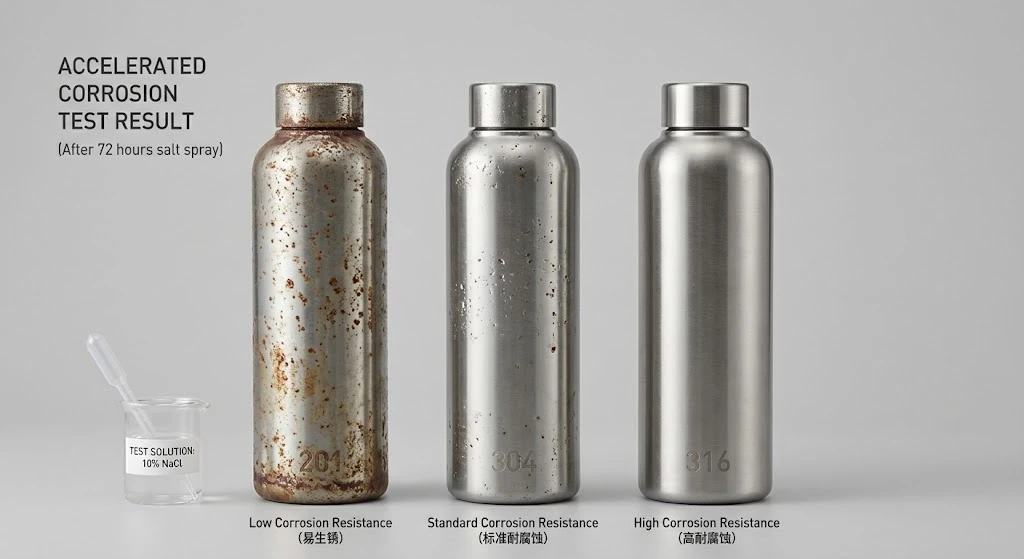
| Corrosion resistance | Low — prone to pitting in moist/salty conditions | High — standard food-grade choice | Very high — chloride/acid resistant |
| Typical relative cost | Lowest (~0.7×) | Baseline (1×) | Highest (~1.4–1.6×) |
| Typical use in drinkware | Budget bottles (not recommended for food contact) | Standard water bottles, tumblers, thermos | Sports bottles (electrolytes), baby/kids, medical-grade |
Why the cost gap exists
Nickel is the most expensive alloying element in austenitic stainless steel. Grade 201 replaces a large share of nickel with manganese, which is why it costs less — and why it corrodes faster. Grade 316 adds molybdenum on top of higher nickel, which is why it commands the highest price[3].
3. Why Grade Choice Matters for Drinkware: Leaching, Taste & Safety
For a brand putting its name on a bottle, the grade is not a cosmetic detail. It directly affects three things your customers will experience:
3.1 Metal ion leaching
Beverages — especially acidic drinks, tea, coffee and electrolyte solutions — can slowly dissolve metal ions from the inner wall of a bottle. Grade 201, with its higher manganese content, has been the subject of consumer-safety concern precisely because manganese and nickel can migrate into drinks over repeated use, particularly if the inner surface is scratched or corroded[4]. Grade 304 and 316 are far more stable under food-contact conditions.
3.2 Taste and odor neutrality
A lower-grade steel that has begun to corrode can impart a metallic taste to water. This is a fast path to bad reviews and returns — a risk no brand should take with its reputation.
3.3 Regulatory compliance
Food-contact materials sold internationally must meet the compliance requirements of their target markets. In the EU, food-contact materials fall under the EU framework for materials intended to come into contact with food; in the US, the FDA regulates food-contact substances[5]. Requirements differ by country, so confirm the exact certification scope with your supplier before production.
4. How to Verify the Grade: 4 Practical Checks for B2B Buyers
A common problem in the drinkware industry is grade substitution — a supplier labeling 201 as 304 to win the order. Here is how to verify what you are actually getting:
- ① Request material test certificates (MTC): Note that suppliers issue certificates for the material batch, not for each individual product. Insist on the material certificate for every shipment.
- ② Use XRF spectroscopy: Handheld XRF analyzers give an instant reading of chromium, nickel and molybdenum content. This is the same technique accredited labs use for metal composition testing.
- ③ Check magnetic response: Austenitic 304/316 are weakly magnetic; heavily cold-worked 201 can show stronger magnetism. This is a rough indicator only, not proof.
- ④ Test corrosion under salt spray: A 48–72 hour salt-spray test will quickly reveal pitting on 201 that 304/316 would survive.
5. Which Grade Should Your Brand Choose? A Decision Matrix
| Your product scenario | Recommended grade | Why |
|---|---|---|
| Standard water bottles / tumblers (water, tea, coffee) | 304 | Best balance of food safety, durability and cost |
| Sports bottles (electrolytes, salty drinks) | 316 | Chloride resistance prevents pitting from salt |
| Baby & kids drinkware, medical-adjacent products | 316 | Highest safety margin; premium positioning |
| Promotional / giveaway items, short product life | 201 (with caution) | Only if not used for food contact; disclose grade honestly |
| Premium / outdoor / marine-adjacent brands | 316 | Supports a premium price point and “medical-grade” story |
Mofecup supplies custom water bottles and tumblers in 304 and 316 stainless steel. Factory material certificates are available on request, and XRF verification can be arranged for specific batches. Whether you need 500 or 50,000 units, our team will help you specify the right grade for your market. Request a quote →
6. Partner With Mofecup for Custom Stainless Steel Drinkware
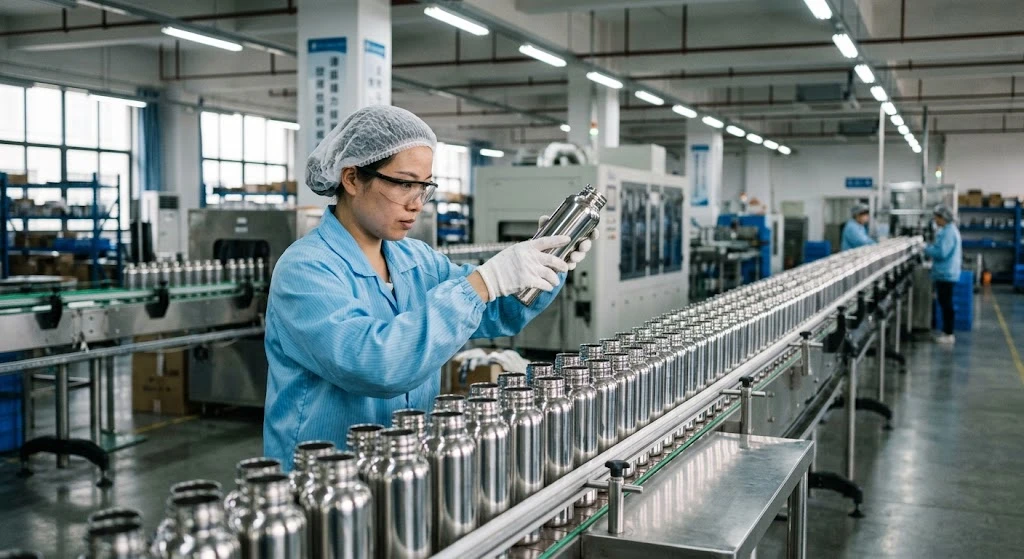
Mofecup is a drinkware supplier offering end-to-end OEM/ODM services:
- 304/316 food-grade stainless steel with factory material certificates available on request.
- Custom branding: laser engraving, screen printing, PVD coating and full-color options.
- Export compliance documentation (CE, FDA and other target-market certifications as required by your market).
- Flexible MOQs and small-batch customization for brand launches.
Footnotes & References
[1] ASTM International. ASTM A240/A240M — Standard Specification for Chromium and Chromium-Nickel Stainless Steel Plate, Sheet, and Strip for Pressure Vessels and for General Applications. 2019. astm.org
[2] British Stainless Steel Association (BSSA). Stainless Steel Grade Datasheets: 201, 304, 316. bssa.org.uk
[3] Outokumpu. Stainless Steel Handbook — Corrosion Resistance and Alloy Design. Technical datasheet, 2018.
[4] United States National Institutes of Health. Manganese and Nickel Release from Stainless Steel Cookware and Drinkware under Simulated Food-Contact Conditions. PubMed indexed study, 2016. pubmed.ncbi.nlm.nih.gov
[5] U.S. Food & Drug Administration. Food Contact Substances (FCS) — Regulatory overview for materials intended to contact food. fda.gov