
Six Trends, One Purchase Order
Translating 2026 Outdoor Demand into Bottle Specifications
Table of Contents
- 1. Large Capacity Is a Different Engineering Class
- 2. The Six 2026 Trends and What Each One Costs You
- 3. Trend 1 — Capacity Climbs: What the Size Class Changes
- 4. Trend 2 — Customization as Core Strategy
- 5. Trend 3 — Insulation Claims Under Scrutiny
- 6. Trend 4 — Material and Sustainability Claims
- 7. Trend 5 — Lid Systems Multiply
- 8. Trend 6 — Smart Features: Where They Help
- 9. What Changes by Region
- 10. The Spec Sheet to Lock Before Tooling
- 11. FAQ
- 12. Partner With Mofecup on an Outdoor Bottle Programme
1. Large Capacity Is a Different Engineering Class
The phrase “large capacity” gets treated as a product attribute — a number on a spec sheet that sits alongside colour and logo placement. For sourcing purposes it is not an attribute. It is a different engineering class, and the difference is worth understanding before a mould is cut.
Two reasons. The first is mass. A filled bottle is what actually gets carried, dropped and shipped, and water is dense: a 32 oz (approx. 946 ml) bottle holds close to a kilogram of water before the vessel itself is counted. A 64 oz (approx. 1.9 L) bottle holds roughly double that. Drop energy scales with mass, so the same fall that dents nothing at 500 ml is a different event at two litres — and the base, handle and lid are all load paths in that event.
The second reason is geometry. A vacuum jacket has to be uniform to work, and the larger the vessel, the longer the weld and seam paths that have to hold that vacuum, and the more surface area over which heat can leak in. A wide platform is also inherently less stable than a narrow one when it is set down on uneven ground.
None of that makes large capacity a bad product. It means the specification work is real, and that a bottle scaled up from an existing small format will not behave like a large one. Treating 64 oz as “the same bottle, bigger” is the most common and most expensive assumption in this category.
This article takes the six demand trends that are actually shaping outdoor drinkware programmes in 2026 and translates each one into what it demands from the bottle, and where its cost lands in your purchase order — moulds, decoration setup, test protocols, documentation and freight. Trend articles usually stop at the observation. The useful part starts after it.
Where this fits with our other guides
This article covers the trend-driven layer — which market shifts force which specification decision, and what each costs. Adjacent decisions live elsewhere:
What outdoor conditions themselves demand (materials, ruggedisation, insulation expectations for adventure use) → custom drinkware for outdoor and camping brands
Vacuum insulation as a technology (wall construction, vacuum pumping, getters) → double-wall vs triple-wall vacuum insulation
How temperature retention is actually tested → verifying temperature retention claims
The neck as the thermal weak point → neck design and heat retention
Lid systems compared → chug, straw and flip lid comparison
Programmes for other athlete and brand segments → fitness and gym brands · sports teams and athletic organisations
2. The Six 2026 Trends and What Each One Costs You
Here is the whole subject on one page. Each trend below is a shift in what buyers ask for; the column that matters to a sourcing team is the third one, because that is where a trend stops being a market observation and becomes a line in the budget.
| Trend | What it demands from the bottle | Where the cost lands |
|---|---|---|
| 1. Capacity climbs (32 → 64 oz) | Bigger cavity, longer vacuum seams, carry geometry becomes structural, base stability must be re-earned | New mould per format; heavier freight; drop test re-run |
| 2. Customisation as core strategy | Decoration must survive wash and abrasion, not just look right in a photo | Decoration setup per artwork; abrasion and wash testing |
| 3. Insulation claims scrutinised | A retention claim with a defined test, ambient condition and fill temperature behind it | Test cycles; re-tests if the format or lid changes |
| 4. Material and sustainability claims | Every environmental or material claim traceable to a document, not a brochure | Recycled-content documentation; migration testing; supplier audit |
| 5. Lid systems multiply | One bottle shell, several closures — each with its own tooling and seal behaviour | Tooling per lid; SKU count and MOQ split across variants |
| 6. Smart and connected features | Electronics in a washable, drop-prone, wet environment | Per-unit component cost; warranty exposure; returns rate |
One pattern is worth naming before the detail. Trends 1, 3, 5 and 6 all push engineering cost upward, and trends 2 and 4 push evidence cost upward. None of them are marketing costs. A brand that answers all six with a bigger marketing budget rather than a tighter specification will have a good campaign and a product that cannot support its own claims.
3. Trend 1 — Capacity Climbs: What the Size Class Changes
Demand is moving up the capacity ladder. The working range for outdoor hydration now sits between roughly 32 oz and 64 oz, with the upper rungs doing the marketing work and the mid rungs doing the volume. What changes as you climb is not just the fill volume.
| Capacity | Approx. water mass when full | What the size class changes | Sourcing consequence |
|---|---|---|---|
| 32 oz (approx. 946 ml) | ≈ 1 kg | Still hand-carryable for hours; integrated handle is convenient rather than necessary | Widest range of existing moulds; the economical entry rung |
| 40 oz (approx. 1.2 L) | ≈ 1.2 kg | The step where one-handed carry starts to fail and a handle or sling becomes the norm | Handle becomes a design task, not a trim option |
| 64 oz (approx. 1.9 L) | ≈ 1.9 kg | Base stability, handle strength and lid load all become structural questions; typically carried in a pack or by a strap | Largest mould; drop test must be run at this mass, not extrapolated |
The mouth opening is the trade you cannot avoid
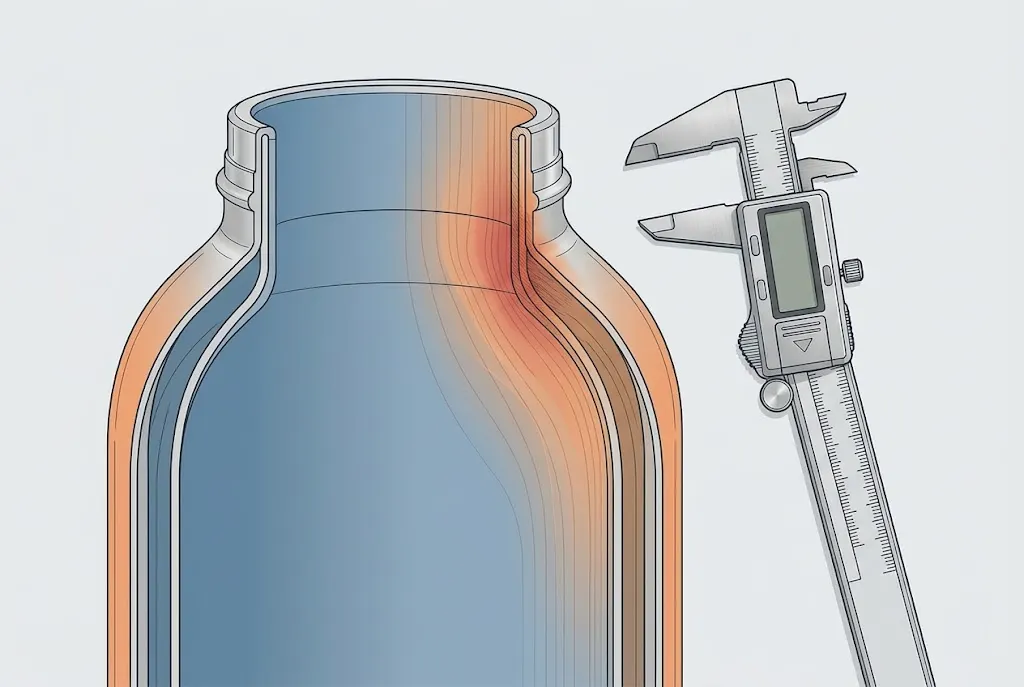
Large-format bottles need a wide opening — for ice, for filling, for getting a brush inside, and for drinking enough at once to matter. A wide opening is also the single largest thermal weak point in an insulated bottle, because the mouth is where the inner and outer walls converge and where heat has the shortest path between them. The wider the mouth, the more heat moves through that junction per unit time.
This is the central engineering tension of the category, and it does not disappear: you are trading thermal performance for usability, and the only question is whether you made the trade deliberately. The ways that trade is managed — neck geometry, copper lining strategy, where the vacuum break sits relative to the thread — are covered in neck design and heat retention, with mouth options in our mouth and neck design guide.
Three things that get specified too late
- Carry geometry. At 40 oz and above, how the bottle is carried determines where the load enters the wall. A handle bonded to a thin shell after the fact concentrates stress at its fixings; integrated geometry spreads it. Handle and sling options are set out in our handle design guide.
- Base stability. A tall, wide vessel filled to two litres is a tipping risk on a rock surface. Base profile — flat, recessed or tapered — is a design decision with a real stability consequence, covered in base design, stability and anti-slip.
- Freight behaviour. Empty, a large bottle is bulky, so dimensional weight can exceed actual weight on consolidated shipments. Full, its mass matters. Two large formats can look identical per unit and land in different freight bands as a packed carton. Our transit durability guide covers how that gets tested rather than assumed.
4. Trend 2 — Customization as Core Strategy
Personalisation has moved from a premium add-on to a baseline expectation, which changes its sourcing character. When a feature is optional, a supplier can work around its limitations. When it is the product’s main proposition, the limitations become the brand’s problem — and decoration durability is where that shows up first.
A logo that looks crisp in a studio photograph and fades at the fortieth dishwasher cycle is not a decoration failure. It is a warranty claim, a one-star review and, in some markets, a substantiation problem for whatever durability statement was printed on the pack. The method choice is therefore an engineering choice, and it should be made against the wash and abrasion conditions the bottle will actually meet.
| Decoration route | How it behaves in service | Setup / tooling character | Where it suits an outdoor programme |
|---|---|---|---|
| Laser marking | Marks the metal itself rather than adding a layer — nothing to peel, flake or wash off | Strongly artwork-dependent; fine gradients and multi-tone designs are not its strength | Best default where the bottle is handled hard, washed often and the mark is monochrome |
| Screen printing | Added ink layer; durability depends on ink system, cure and surface prep | Per-colour setup; efficient at volume, expensive for small runs | Where colour and coverage matter and volumes justify the setup |
| High-temperature decals | Fired into the surface; strong resistance but needs a substrate that tolerates the firing | Kiln cycle adds lead time and constrains which bodies can be used | Not typically the route for stainless vacuum bottles; see decals vs screen printing |
| Powder coating / anodising / plating | Provides the body colour itself; chip resistance becomes a surface question rather than an ink question | Process-based, not artwork-based — good fit with multi-variant ranges | Suits colour-led ranges; see anodising guide and finish options |
Two practical points. First, specify the durability claim before choosing the method, not after — “survives 500 dishwasher cycles without visible loss of legibility” is a specification; “durable print” is not. Second, abrasion and wash resistance are testable, and the methods exist: abrasion resistance of printed and coated surfaces is covered by established test methods, and UV and colour-fade behaviour under exposure has its own protocols. Our guides on UV and fade testing, dishwasher safety and logo application methods compared go through the options in detail.
5. Trend 3 — Insulation Claims Under Scrutiny
Retention numbers are now the headline specification in outdoor drinkware, and they are also the easiest claim to make and the hardest to defend without a test behind it. A phrase like “keeps cold for 24 hours” is not a specification until three things are attached to it: the ambient temperature, the starting fill temperature and the end-point threshold. Change any one of them and the same bottle produces a different number.
That is not a technicality. It is the reason two suppliers can both be honest and quote 24 hours and 12 hours for the same construction. The comparison only becomes meaningful when the test conditions are written down, which is why the retention claim in your specification should carry its method with it.
| Claim element | Why it changes the number | What to have on file |
|---|---|---|
| Ambient temperature | Heat flows faster the wider the gap between ambient and contents. A hot-region claim and a cold-region claim are different claims. | The controlled ambient used, and the tolerance around it |
| Starting fill temperature | A fill at 4 °C and a fill at 1 °C are not the same test, and neither is a pre-chilled vessel versus one filled at room temperature | Fill temperature and whether the bottle was pre-conditioned |
| End-point threshold | “Still cold” is not a number. A threshold of 10 °C and one of 15 °C are separated by hours of retention. | The pass/fail threshold in degrees, and the number of sensor points |
| Fill level and lid state | A partly filled bottle has more air and less thermal mass; a lid left off changes the result completely | Fill volume as a proportion of capacity; lid model used |
| Which lid was fitted | Lid insulation is part of the system. A straw lid and a sealed cap on the same shell do not retain equally. | The tested bottle-lid combination, stated as a combination |
There is a China-specific point worth knowing for programmes sourced there: stainless vacuum flasks have a national standard covering retention performance and structural requirements, and it is the method most factories in that supply base test against by default. That matters practically — when a supplier says a bottle meets the standard, the useful follow-up is which clause, at what ambient, to what threshold. Method detail and the parameter traps are set out in verifying temperature retention, and the physics of the jacket itself in vacuum insulation construction[10][9].
One honest limit on all of this: a retention test cannot tell you how long the vacuum will last. Lambda value and construction determine how well the jacket insulates while intact; they say nothing about whether it will still be intact after two winters of drops. Loss of vacuum is a failure mode that shows up in service, and it is detected by testing — not predicted by a datasheet. Our guides on drop testing and assembly integrity and thermal shock and temperature abuse cover the abuse side.
6. Trend 4 — Material and Sustainability Claims
Sustainability demand in outdoor gear has a specific sourcing consequence that is easy to underestimate: it converts marketing language into documentation requirements. Recycled content, “free-from” statements and recyclability are all claims about the physical article, and in major markets environmental marketing claims are expected to be substantiated rather than aspirational[1].
In practice that means the sustainability trend does not show up in your budget as a premium on the material. It shows up as evidentiary cost — certificates, test reports and supplier declarations that have to exist before the claim can be printed.
| Claim commonly made | What actually substantiates it | Where programmes get caught out |
|---|---|---|
| Recycled stainless steel content | A traceable recycled-content figure for the specific coil or batch, held by the mill and passed through the chain | Assuming an industry-average figure applies to the actual material purchased |
| Recyclable / widely recycled | That the material is genuinely recyclable and that the claim is not overstated for the market it is sold in | Conflating “the material is recyclable” with “this product will be recycled”; a mixed-material assembly with a bonded lid is the usual gap |
| PFAS-free | A declaration covering the coatings, seals and any water-repellent treatment — not only the bottle wall | Scope. A PFAS statement about the body says nothing about the gasket or the printing. Regulatory attention on per- and polyfluoroalkyl substances has widened considerably[2] |
| BPA-free | Relevant to the plastic components — lid bodies, seals, straws — and documented for those parts | Printing it on a stainless bottle where the only plastic is the lid: true but not informative, and still needs the lid declaration behind it |
| Food-grade / food-safe | Compliance with the food-contact framework of each destination market, for every material in contact with the drink | One test certificate offered for a product sold into three markets with different frameworks |
The material does not start and stop at the bottle wall
An insulated bottle is an assembly. Its food-contact surfaces include the inner wall, the gasket, the lid interior, the straw if fitted, and the decoration if it sits on a surface the drink can reach. Each of those is regulated as a separate material: metallic food-contact components in China fall under a dedicated mandatory standard[6], polymer components under the polymer provisions in the United States[4], and coating and adhesive components under theirs[3], all framed in the EU by the general food-contact regulation[5].
So when a brief says “food-grade, sustainable, PFAS-free”, the sourcing translation is not a material change. It is a documentation matrix: which component, which market, which test, which certificate. Our migration testing guide, materials by application and recycled-material guide walk through it component by component. Steel supply itself has a well-established recycling story, and industry data on stainless steel end-of-life recovery is available for anyone wanting a citable figure rather than a slogan[11].
7. Trend 5 — Lid Systems Multiply
Buyers increasingly want one bottle that serves several activities — a straw lid for running, a chug lid for fast hydration, a sealed cap for a pack. Commercially that is attractive: one shell, several configurations, one product page with variants. The tooling arithmetic behind it is less attractive, and it is worth doing before committing to a range.
| Configuration | What it adds to the programme | Tooling and MOQ consequence |
|---|---|---|
| Single sealed cap | Best retention behaviour of the options and the simplest leak path to control | One lid tool, one SKU, full order volume in a single item |
| + straw lid | Convenience for running and cycling; adds a straw and its cleaning requirement | Second tool plus components; order volume now splits two ways |
| + chug lid | High-flow drinking without removing the cap; favoured for endurance use | Third tool; seal behaviour differs and needs its own leak verification |
| + loop / carry cap | Attachment point for packs and slings; matters more as capacity rises | Additional tool; load-bearing geometry should be tested, not assumed |
The SKU arithmetic buyers forget
Here is an illustrative calculation, and the point is the structure rather than any particular figure — run it with your own order quantities and prices.
Suppose a programme plans 12,000 units across a shell. As a single configuration, all 12,000 sit in one volume band and pay one tool. Split across four lid systems and that becomes 3,000 units per variant — which may fall below one or more of the supplier’s price break points, and now pays four tools instead of one. The shells did not change. The unit cost did, because the order stopped being one order and became four smaller ones.
This is not an argument against lid ranges. It is an argument for deciding the range against the volume you can actually place into each variant, and for treating a lid as a separate product with its own tooling, its own seal verification and its own leak test rather than as an accessory. Our comparison of chug, straw and flip lid engineering, the lid selection guide, straw lid engineering and drink-through lid design cover the mechanics; the ordering economics sit in small-batch economics and MOQ, lead time and payment terms.
8. Trend 6 — Smart Features: Where They Help
Temperature-display lids, hydration reminders and app-connected bottles are a real trend and a real differentiator in a crowded category. They are also the trend where the gap between a concept and a shippable product is widest, because the product is a rigid container that gets dropped, filled with ice, left in a hot car and put in a dishwasher — and the feature is electronics.
Rather than debate whether smart bottles are a good idea, the useful exercise is to price the exposure. Four questions decide whether a smart feature belongs in your range.
| Question | If the answer points this way | If it points the other way |
|---|---|---|
| Is the module in the lid only, or does it penetrate the bottle? | Lid-only: the shell stays a standard product and the electronics become a replaceable part | Penetrating: the vacuum jacket gets a feed-through, which is a leak path and a warranty question |
| What water and temperature spec does the module carry? | Specified for wash and freeze-thaw, with the spec written down | Unspecified: returns will be discovered in the field, not in the sample room |
| Can a failed module be replaced without scrapping the bottle? | Replaceable: a unit-cost problem | Sealed in: a full-product replacement problem |
| Does the claim depend on an app? | The bottle works fully without it; the app is an extra | App-dependent: you have taken on software support obligations for the life of the product |
The pattern: smart features are worth doing when the electronics are contained, replaceable and optional. They are a poor fit when they penetrate the insulated structure or when the product’s core promise depends on a service you will have to maintain. A lid-only module is also the version that lets you keep a standard shell across your whole range — which brings the conversation straight back to section 7’s tooling arithmetic.
9. What Changes by Region
Regional preferences in this category are usually described as taste. For sourcing purposes they are better described as different specifications and different paperwork. One product sold into four markets is four compliance exercises, and knowing which parameters move saves a re-spec later.
| Region | What shifts in the specification | What shifts in the documentation |
|---|---|---|
| North America | Largest formats carry the most weight; retention numbers are the headline claim; ruggedisation and drop performance are expected | Food-contact clearances for each material; environmental claims expected to be substantiated[1] |
| Europe | Insulation performance matters most in cold-climate markets; sustainability is a purchase criterion rather than a differentiator | EU food-contact framework applies across the range[5]; substance-level scrutiny is active, including on PFAS[2] |
| Asia-Pacific | Portability, styling and multi-function use rank above maximum capacity; mid-size formats sell where 64 oz formats do not | Domestic metal food-contact standard for the local market[6]; retention performance conventionally tested to the national vacuum flask standard[10] |
| Latin America and other warm-climate markets | Year-round use places greater weight on cold retention specifically; price sensitivity means the specification has to earn each premium | Documentation often follows the destination partner’s requirement; worth agreeing who holds what before the order |
Practical takeaway: choose the shelf format and the documentation matrix per market, and keep the shell common. The shell is what carries the tooling cost and the amortisation base. The claim, the carton and the certificate file are what vary — and those are cheaper to vary than a mould.
10. The Spec Sheet to Lock Before Tooling
Everything above collapses into one document. These are the parameters that decide whether a 2026 outdoor programme is deliverable, and the point at which each one stops being adjustable.
| Parameter | Decide it by asking | Cost of locking it late |
|---|---|---|
| Capacity and format count | Which rungs does the range actually need, and what does each one do commercially? | A new mould and a reset amortisation base |
| Mouth diameter | Ice cubes, filling, cleaning and drinking flow — against the retention target you are willing to defend | Retention re-test; incompatible lids and components |
| Wall thickness and vacuum design | Is this carried in a pack, on a sling, or dropped on rock? What abuse is in scope? | Vacuum loss and dent complaints discovered in service |
| Carry geometry | Integrated, detachable, or no handle — and where does the load enter the wall? | Handle failures at the fixings, on the heaviest formats |
| Retention claim and its test conditions | Ambient, fill temperature, end-point threshold, fill level, lid model — written down | A claim on the packaging you cannot reproduce in a test |
| Decoration method and durability target | Wash cycles expected, abrasion exposure, and the claim that must survive them | Faded logos and returns well after the first production run |
| Lid range and SKU split | Volume per variant, tooling per lid, and whether each variant clears a price break | Unit costs that rise as the range grows |
| Component food-contact matrix | Every market × every contacting component: wall, gasket, lid, straw, coating | A container that clears one market and stalls in another |
| Environmental claim file | What each claim needs behind it, and who holds the evidence | A claim withdrawn from packaging after print |
| Transit and carton configuration | The configuration actually shipped, tested as shipped rather than assumed | Damage at scale in a pack that was never tested at that mass |
| Reference samples | Which physical pieces define “correct” for the next two years — shell, colour, lid, print | Reorders that become arguments rather than checklists |
Most of this gets settled at sampling, which is also the cheapest stage at which to change your mind. Our sampling process guide covers what a useful sample round should produce, dimensional tolerance testing covers the measurements worth recording, and one-piece versus two-piece construction covers the structural decision underneath the wall specification. Transit performance against a recognised distribution simulation protocol is covered by ASTM D4169 and the ISTA series[7][8].
11. FAQ
What capacity is right for an outdoor programme?
There is no universal answer, but the working range is established: 32 oz as the widely carried standard, 40 oz where a handle becomes normal, and 64 oz as the top format carried in a pack or by a strap. The most common structural mistake is offering four capacities because the range looks complete. Each format needs its own mould and its own amortisation base, so the useful question is which rungs sell enough to carry that cost — usually two or three, not four.
Does a bigger bottle keep drinks cold for longer?
Not automatically, and the reason is worth knowing. A larger volume of liquid has more thermal mass, which helps retention. But a larger bottle also has more surface area and longer vacuum seams, and if it uses a wider mouth — which large formats usually do — it has a shorter path for heat to travel at the neck. The two effects pull in opposite directions, so a 64 oz format with an oversized mouth can underperform a well-designed 32 oz one. Retention is a result of construction and mouth design, not of capacity alone.
Why do two suppliers quote different retention hours for similar bottles?
Because retention is only meaningful with its test conditions attached. Ambient temperature, starting fill temperature, the temperature threshold used as the end point, the fill level and the lid fitted all change the number. Both suppliers can be honest and disagree. The fix is procedural rather than commercial: require the method, the ambient, the threshold and the fill level alongside the hours, and compare like with like.
Should the retention claim be re-tested when the lid changes?
Yes. Lid insulation is part of the thermal system, not an accessory to it. A straw lid and a sealed cap on the same shell will not retain identically, and the mouth area is where most heat moves. State the claim as a bottle-plus-lid combination and test it that way — otherwise the claim quietly stops being true the first time a variant is added.
Is stainless steel the right material for outdoor use?
For insulated outdoor bottles it is the mainstream choice, and the reasons are structural rather than fashionable: it takes a vacuum jacket, it resists denting better than thin-walled alternatives, it tolerates the drop and abrasion exposure this category sees, and it has an established recycling route at end of life. The grades differ in corrosion resistance, and for outdoor use salt exposure and coastal environments are the conditions that separate them — covered in our stainless steel grade comparison and salt spray testing guide. Where weight is the dominant design driver rather than dent resistance, the trade-off against titanium is set out in titanium versus stainless steel.
Can one bottle be sold with several different lids?
Yes, and it is one of the more effective ways to broaden a range from a single shell. Do the arithmetic first: each lid is its own tool, its own seal behaviour and its own leak verification, and splitting a fixed order quantity across more variants reduces the volume in each one — which can move you below a supplier’s price break points and raise the unit cost of every variant. A lid range is a good idea when the volume per variant still clears a sensible quantity band.
Does customization affect insulation performance?
It can, depending on how it is done. Decoration applied as an added layer on the exterior does not change the vacuum jacket, but a process that involves heat, or a design that adds a bonded component to the shell, can affect the surface and the structure. The relevant question for a brief is not “does customisation hurt insulation” but “does this specific process touch the insulated structure” — and if the answer is yes, it belongs in the sample round as a tested configuration rather than a decorative choice.
What has to be decided before the mould is cut?
Everything structural: capacity and format count, mouth diameter, wall thickness and vacuum design, and how the bottle is carried. All four are set by the mould or by the sample approval that follows it, and all four are expensive to revisit once production tooling exists. The list in section 10 is the working version. In our experience the two most often left too late are mouth diameter and carry geometry — and they are the two that most directly determine whether the retention claim and the durability claim survive contact with real use.
Planning a large-capacity insulated bottle range for 2026?Tell Mofecup the formats, the activities and the markets you are targeting, and we will come back with a costed specification rather than a single price: mould and decoration setup per format, unit cost at your actual order quantity, lid tooling options and the volume each variant needs to clear its price break, the retention claim with its test conditions written out, the component-by-component food-contact documentation your markets require, and a transit-tested carton configuration for the mass you are actually shipping. We will also say plainly when a format or a claim does not earn its cost in your range. Request a quote →
12. Partner With Mofecup on an Outdoor Bottle Programme
Mofecup produces custom insulated bottles and drinkware for outdoor brands, sports and active-lifestyle companies, promotional programmes and private label. On a large-capacity programme our role is to translate the market picture into a specification a production partner can hit repeatably — and to flag the parts of a brief that will not survive tooling before a mould is cut.
In practice that means:
- Formats chosen against the volume each one can carry, not against a template range — with a direct answer on which rungs are worth a mould.
- Mouth and neck specified against your retention target, so usability and performance are traded deliberately rather than by default — see mouth and neck design.
- Retention claims stated as testable combinations — ambient, fill temperature, threshold, fill level and lid, written into the specification.
- Carry geometry and base stability engineered for the filled mass, not added afterwards — see handle design and base design.
- Decoration matched to the wash and abrasion conditions it will actually meet, with the durability claim defined rather than implied — see logo application methods.
- A component-by-component food-contact and claim file for your destination markets — wall, gasket, lid, straw, coating, decoration.
- Transit-tested packaging for the configuration you ship, at the mass you ship it at — see transit durability testing.
- A costed comparison across formats and lid variants, so the range decision is made on the numbers it will be judged on.
For the wider picture, the conditions-specific view for adventure use sits in outdoor and camping brand drinkware, material selection across applications in our materials by application guide, and other athlete-facing segments in sports teams and athletic organisations and fitness and gym brands. Or send your brief and we will respond with the formats, the specification and the costed options.
Footnotes & References
[1] U.S. Federal Trade Commission. Guides for the Use of Environmental Marketing Claims (“Green Guides”) — codified at 16 CFR Part 260. Sets out the Commission’s guidance on substantiating environmental marketing claims, including recycled-content, recyclability and free-of claims. ecfr.gov
[2] U.S. Environmental Protection Agency. PFAS — Per- and Polyfluoroalkyl Substances — the EPA’s information hub on PFAS, covering the agency’s regulatory and research activity on this group of substances. epa.gov
[3] U.S. Electronic Code of Federal Regulations. 21 CFR Part 175 — Indirect food additives: Adhesives and components of coatings. Governs substances used as components of adhesives and coatings for food-contact articles — the framework relevant to decorated surfaces and bonded components. ecfr.gov
[4] U.S. Electronic Code of Federal Regulations. 21 CFR Part 177 — Indirect food additives: Polymers. Governs polymer substances used in food-contact articles — the framework relevant to lid bodies, seals, gaskets and straws. ecfr.gov
[5] European Parliament and Council. Regulation (EC) No 1935/2004 on materials and articles intended to come into contact with food. The general EU framework applying to all food-contact materials, including the requirement that they not transfer constituents in quantities that endanger health or unacceptably change the food. eur-lex.europa.eu
[6] National Health Commission of the People’s Republic of China. GB 4806.9 — National food safety standard: Metal materials and articles in contact with food (食品安全国家标准 · 食品接触用金属材料及制品), a mandatory standard in the GB 4806 series for food-contact materials. chinesestandard.net
[7] ASTM International. ASTM D4169 — Standard Practice for Performance Testing of Shipping Containers and Systems. A distribution simulation protocol used to qualify a shipping configuration against a defined sequence of handling and transport hazards. astm.org
[8] International Safe Transit Association (ISTA). ISTA test protocols for packaged-product performance. A series of transit test procedures commonly used alongside ASTM D4169 to qualify packaged products for a defined distribution environment. ista.org
[9] The Engineering ToolBox. Thermal Conductivity of Common Materials and Gases. Reference values for the thermal conductivity of materials and of still air — the property that explains why evacuating the space between two walls is more effective than filling it with any solid insulator. engineeringtoolbox.com
[10] Standardization Administration of the People’s Republic of China. GB/T 29606 — Stainless steel vacuum flask (不锈钢真空杯). The national standard covering insulation performance and structural requirements for stainless steel vacuum flasks and bottles; searchable on China’s official standards platform. openstd.samr.gov.cn
[11] World Stainless Association. Stainless steel and the circular economy — industry data and lifecycle information on stainless steel, including end-of-life recovery and recycling rates for the material. worldstainless.org