Titanium vs Stainless Steel Water Bottles
Weight, Insulation & Safety Compared
Table of Contents
- 1. Titanium vs Stainless Steel: The Basics
- 2. Side-by-Side Comparison Table
- 3. Weight & Portability: The Real Difference
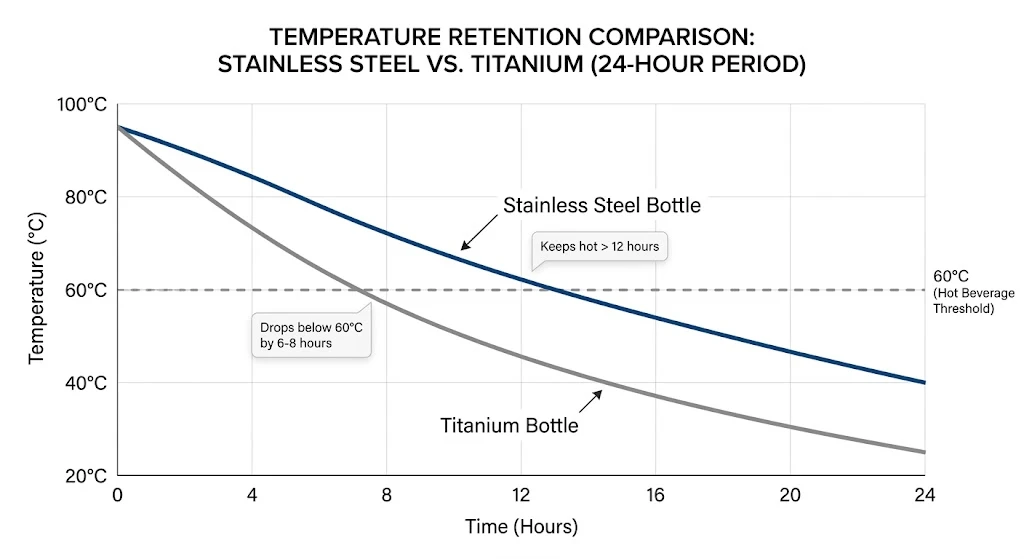
- 4. Insulation: Which Keeps Drinks Hot or Cold Longer?
- 5. Taste, Safety & Metal Leaching
- 6. Cost & Value: Why Titanium Costs More
- 7. Decision Matrix: Which Should Your Brand Choose?
- 8. Partner With Mofecup
1. Titanium vs Stainless Steel: The Basics
When sourcing premium water bottles, titanium and stainless steel are the two materials customers most often compare. Both are corrosion-resistant, durable and food-safe — but they serve very different price points and buyer expectations. Understanding the trade-offs is essential before you commit to a material for your brand[1].
Stainless steel (typically 304 or 316) is the industry workhorse: proven, affordable, excellent for insulation. Titanium is the lightweight premium alternative: roughly 45% lighter than steel, naturally inert, and priced at a significant premium.
2. Side-by-Side Comparison Table
Here is the head-to-head comparison that matters for drinkware sourcing:
| Property | Titanium | Stainless Steel (304/316) |
|---|---|---|
| Weight | ~45% lighter ✅ | Heavier (baseline) |
| Tensile strength | Comparable per-weight, higher strength-to-weight ratio | Very strong, thicker walls typical |
| Corrosion resistance | Excellent — naturally inert, no coating needed | Excellent (304/316), but may pit in extreme conditions |
| Taste neutrality | Completely neutral — no metallic taste ✅ | Neutral when undamaged; slight taste possible if corroded |
| Insulation (vacuum double-wall) | Good, but weaker than steel for long-duration heat retention | Excellent — industry standard for 12-24h retention ✅ |
| Surface finish options | Limited (brushed, sandblasted, anodized colors) | Very wide (powder coat, PVD, printing, engraving) ✅ |
| Typical price | 2–4× steel (premium) | Baseline (affordable) |
| Best for | Ultralight outdoor/ultra-premium brands | Everyday use, insulation-first products, most budgets |
3. Weight & Portability: The Real Difference
Titanium’s defining advantage is weight. A typical 500ml titanium bottle weighs roughly 150–180g, while an equivalent stainless steel bottle weighs about 280–350g[2]. For hikers, cyclists and travelers who carry water all day, that difference is decisive.
However, lighter walls also mean less material for heat retention — which is why titanium bottles rarely match steel for long-duration insulation (see next section).
4. Insulation: Which Keeps Drinks Hot or Cold Longer?
Insulation performance depends on the vacuum double-wall design and the material’s thermal properties. Stainless steel has lower thermal conductivity than titanium in practical bottle-wall terms, and manufacturers have decades of proven double-wall vacuum manufacturing experience with steel. As a result:
- Stainless steel: 12–24 hours of hot/cold retention is standard for quality double-wall bottles.
- Titanium: Typically 4–8 hours for similar designs — acceptable for day-use, weaker for overnight.
If your product story is “keeps coffee hot all day,” stainless steel wins. If it’s “ultralight for the trail,” titanium wins[3].
5. Taste, Safety & Metal Leaching
Both materials are food-safe when properly manufactured. The differences:
- Titanium: Naturally inert — it does not react with acidic drinks and never imparts a metallic taste. This is why titanium is used in medical implants and high-end cookware[4].
- Stainless steel (304/316): Food-safe and stable, but lower grades (e.g. 201) can leach manganese or nickel over time, particularly with acidic beverages. Always specify 304 or 316 for food contact[5].
6. Cost & Value: Why Titanium Costs More
Titanium bottles typically cost 2–4× more than equivalent stainless steel bottles. The reasons: raw titanium is expensive to refine, forming and welding thin titanium is more difficult, and production volumes are far lower. For a brand, this means:
- Higher margin potential — but also a smaller addressable market.
- Longer lead times — fewer factories produce titanium drinkware at scale.
- Higher MOQ risk — committing to titanium inventory is a bigger bet.
7. Decision Matrix: Which Should Your Brand Choose?
| Your brand scenario | Recommended material | Why |
|---|---|---|
| Everyday hydration, office, commuting | Stainless steel 304 | Best all-round value; excellent insulation |
| Outdoor / hiking / ultralight travel | Titanium | Weight saving is decisive for carry-all-day use |
| Premium / luxury brand positioning | Titanium | “Medical-grade titanium” story supports premium pricing |
| Sports / electrolytes / kids | Stainless steel 316 | Chloride resistance + proven safety record |
| First product launch, limited budget | Stainless steel 304 | Lower MOQ risk; faster iteration |
Mofecup supplies custom stainless steel drinkware (304/316) with factory material certificates, and can advise on titanium sourcing for premium lines. Tell us your target market and budget, and our team will recommend the right material. Request a quote →
8. Partner With Mofecup
Mofecup is a drinkware supplier offering end-to-end OEM/ODM services:
- 304/316 food-grade stainless steel with factory material certificates available on request.
- Custom branding: laser engraving, screen printing, PVD coating and full-color options.
- Export compliance documentation (CE, FDA and other target-market certifications as required).
- Flexible MOQs and small-batch customization for brand launches.
Related reading: 201 vs 304 vs 316 stainless steel explained and double-wall vs single-wall insulation.
Footnotes & References
[1] ASTM International. ASTM B265 — Standard Specification for Titanium and Titanium Alloy Strip, Sheet, and Plate. astm.org
[2] Physical property data: density of titanium 4.5 g/cm³ vs stainless steel 7.9 g/cm³. MatWeb Material Property Data. matweb.com
[3] Thermal conductivity comparison: titanium ~17 W/m·K vs stainless steel ~16 W/m·K (similar), but wall thickness differences drive practical insulation performance. Engineering Toolbox. engineeringtoolbox.com
[4] U.S. National Institutes of Health. Titanium biocompatibility and corrosion resistance in medical applications. PubMed indexed literature. pubmed.ncbi.nlm.nih.gov
[5] U.S. Food & Drug Administration. Food Contact Substances (FCS) — regulatory overview. fda.gov