
Chug Lid vs. Straw Lid vs. Flip Lid
Engineering Comparison for Custom Bottles
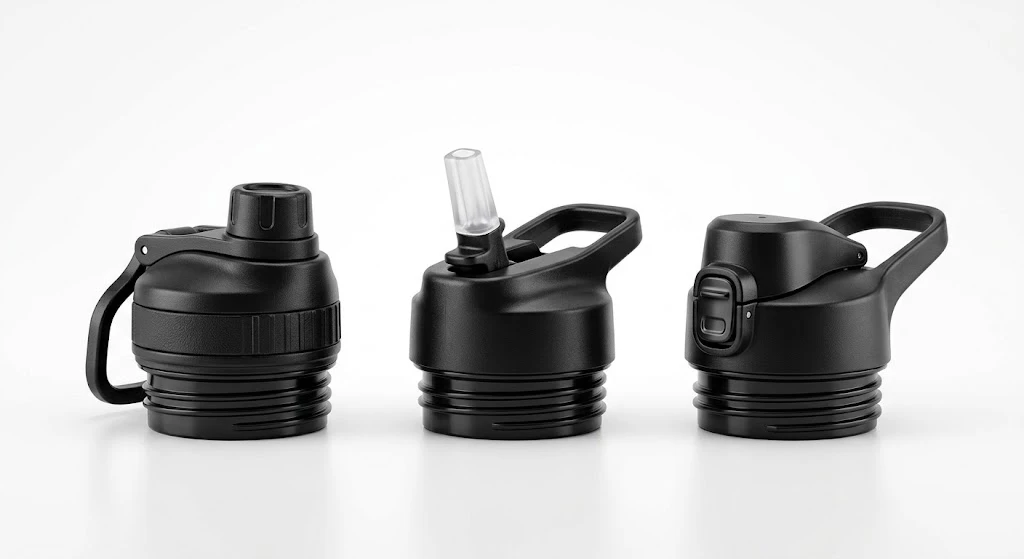
Table of Contents
- 1. Lid System Engineering Overview
- 2. Chug Lid Engineering
- 3. Straw Lid Engineering
- 4. Flip Lid Engineering
- 5. Material Selection for Lid Components
- 6. Selecting the Right Lid for Your Program
- 7. Partner With Mofecup
1. Lid System Engineering Overview
The lid system is arguably the most functionally critical component of any custom water bottle. For B2B buyers sourcing bottles for corporate wellness programs, outdoor retail, sports teams or hospitality, the lid design directly determines user satisfaction, spill resistance, cleaning ease and long-term durability[1].
Three lid architectures dominate the market: chug lids, straw lids and flip lids. Each represents distinct engineering trade-offs in flow rate, sealing mechanism, part count and user ergonomics. The table below summarizes the key engineering parameters that differentiate these three systems[2]:
| Parameter | Chug Lid | Straw Lid | Flip Lid |
|---|---|---|---|
| Peak flow rate (16 mm orifice) | 35–45 mL/s ✅ | 8–12 mL/s | 15–25 mL/s |
| Seal mechanism | Screw-cap gasket + O-ring | Silicone straw grommet + cap seal | Spring-loaded poppet or ball valve |
| Sealing surfaces | 1–2 ✅ | 2–3 | 3–5 |
| One-hand operation | No (two hands to unscrew) | Partial (press-to-open on some) | Yes (thumb latch) ✅ |
| Total part count | 3–5 ✅ | 4–7 | 6–12 |
| Primary failure mode | Gasket wear / cross-threading | Straw detachment / grommet tear | Spring fatigue / hinge breakage |
2. Chug Lid Engineering
2.1 Flow dynamics and hydration efficiency
The chug lid — also called a wide-mouth or open-top cap — is the simplest lid architecture. A 16 mm circular opening produces a peak flow rate of 35–45 mL/s, delivering ~500 mL of water in 11–14 seconds. This makes chug lids optimal for rapid hydration: post-workout, athletic sideline use, or high-intensity occupational environments (construction, manufacturing, warehouse)[3].
2.2 Sealing and leak prevention
The chug lid’s sealing system is straightforward: a silicone or EPDM gasket compresses against the bottle neck rim when tightened — a single sealing interface. Torque spec is typically 15–25 in·lbf (1.7–2.8 N·m), beyond which cross-threading becomes a risk. Fewer sealing surfaces mean fewer leak paths, but any gasket degradation causes immediate leakage. Specify gasket hardness of Shore A 50–65 with good compression-set resistance for long-term reliability.
2.3 Manufacturing complexity and cost
With only 3–5 injection-molded components, chug lids are the most cost-effective option: tooling $3K–$6K, per-unit cost $0.15–$0.30 at 10K+ volumes. Low part count also simplifies quality control.
3. Straw Lid Engineering
3.1 Flow restriction by design
Straw lids incorporate a drinking straw (bore 5–8 mm) that creates a deliberate flow restriction — a 6 mm straw produces 8–12 mL/s, roughly one-quarter the flow of a chug lid. This is an intentional feature for controlled, spill-resistant drinking. Engineering considerations: straw wall thickness (0.5–1.0 mm silicone), inner diameter smoothness, and pickup angle (15–30° from vertical) to minimize dead volume.
3.2 Spill resistance and seal architecture
Straw lids achieve spill resistance through 2–3 sealing interfaces: the silicone grommet around the straw, the lid-to-bottle gasket, and the cap covering the straw opening. For travel, school and office use — where bags contain the bottles — the enhanced spill resistance often justifies the higher cost.
3.3 Cleaning and hygiene
Straw lids have the highest cleaning burden — the straw interior accumulates biofilm if not cleaned regularly. Institutional buyers should specify dishwasher-safe straw designs or removable straws with brush access to maintain hygiene standards.
4. Flip Lid Engineering
4.1 One-hand operation mechanism
Flip lids are the most mechanically complex of the three. A spring-loaded spout opens with a thumb-actuated button. The cam-latch system must hold the spout closed under internal pressure (up to 15–30 psi from thermal expansion) while releasing smoothly. Actuation force is critical: 3–5 N at the button center is the target — below 2 N opens accidentally, above 8 N is uncomfortable.
4.2 Valve, seal engineering & reliability
Flip lids employ the most complex seal architecture (3–5 interfaces), and the spring mechanism degrades over 5,000–20,000 actuation cycles. MTBF is the key reliability metric — accelerated life testing per ASTM D4168 (10,000 open-close cycles) is the industry standard. Results below 5,000 cycles indicate failure within 6–12 months of daily use[4].
Lid Comparison Matrix
| Factor | Chug Lid | Straw Lid | Flip Lid |
|---|---|---|---|
| Best use case | Gym, sports, rapid hydration | Office, school, travel, bags | Driving, cycling, one-hand |
| Cleaning difficulty | Low ✅ | High | Medium |
| Estimated lifespan (daily use) | 3–5 years ✅ | 1–3 years | 1–2 years |
| Tooling cost | $3K–$6K ✅ | $5K–$12K | $10K–$25K |
| Per-unit cost (10K+ qty) | $0.15–$0.30 ✅ | $0.30–$0.80 | $0.50–$1.50 |
5. Material Selection for Lid Components
5.1 Polypropylene vs Tritan vs ABS
PP is the most common lid material (chemical resistance, low cost, dishwasher-safe) but has lower impact resistance (Izod 0.5–2.0 ft·lb/in). Tritan offers the best balance for premium programs: clarity (90%+ light transmission), impact strength (2.5–4.0), and BPA-free certification. ABS provides superior rigidity for complex flip-lid geometries but may yellow under UV exposure.
5.2 Gasket material specification
Silicone (VMQ) is the preferred gasket material: service temperature −40°C to 200°C, compression-set resistance below 20%, FDA-compliant. EPDM is a lower-cost alternative with similar performance but poorer oil resistance. Specify Shore A 50–60 for chug lids, Shore A 40–50 for flip-lid seals[5].
6. Selecting the Right Lid for Your Program
The lid decision should be driven by end-user behavior rather than cost alone:
- Athletic / outdoor brands → chug lid: lowest cost, highest satisfaction for quick-drink scenarios.
- Corporate / travel / education → straw lid: best spill resistance despite higher unit cost.
- Cycling / commuting / fitness → flip lid: one-hand operation commands a functional premium you can pass through to retail pricing.
Mofecup produces all three lid architectures with in-house mold design and injection molding capabilities. Our engineering team can optimize lid geometry, sealing force and ergonomic actuation for your product requirements. Request a quote →
7. Partner With Mofecup
Mofecup is a drinkware supplier offering end-to-end OEM/ODM services:
- All three lid architectures (chug, straw, flip) with in-house mold design and injection molding.
- Lid engineering optimization: geometry, sealing force, ergonomic actuation.
- Custom branding: laser engraving, screen printing, PVD coating and full-color options.
- Flexible MOQs and small-batch customization for brand launches.
Related reading: titanium vs stainless steel bottles and double-wall vs triple-wall insulation.
Footnotes & References
[1] U.S. Food & Drug Administration. Food Contact Substances (FCS) — regulatory overview for bottle and lid materials. fda.gov
[2] Eastman Chemical Company. Tritan Copolyester — technical datasheet (impact strength, clarity, BPA-free). eastman.com
[3] Engineering Toolbox. Orifice discharge coefficient and flow rate fundamentals. engineeringtoolbox.com
[4] ASTM International. ASTM D4168 — standard practice for life-cycle testing of closure mechanisms. astm.org
[5] Shin-Etsu Silicone. Silicone (VMQ) elastomer properties — service temperature and compression set. shinetsusilicone-global.com