Do Insulation Claims Hold Up?
How to Verify Vacuum Performance Before You Buy
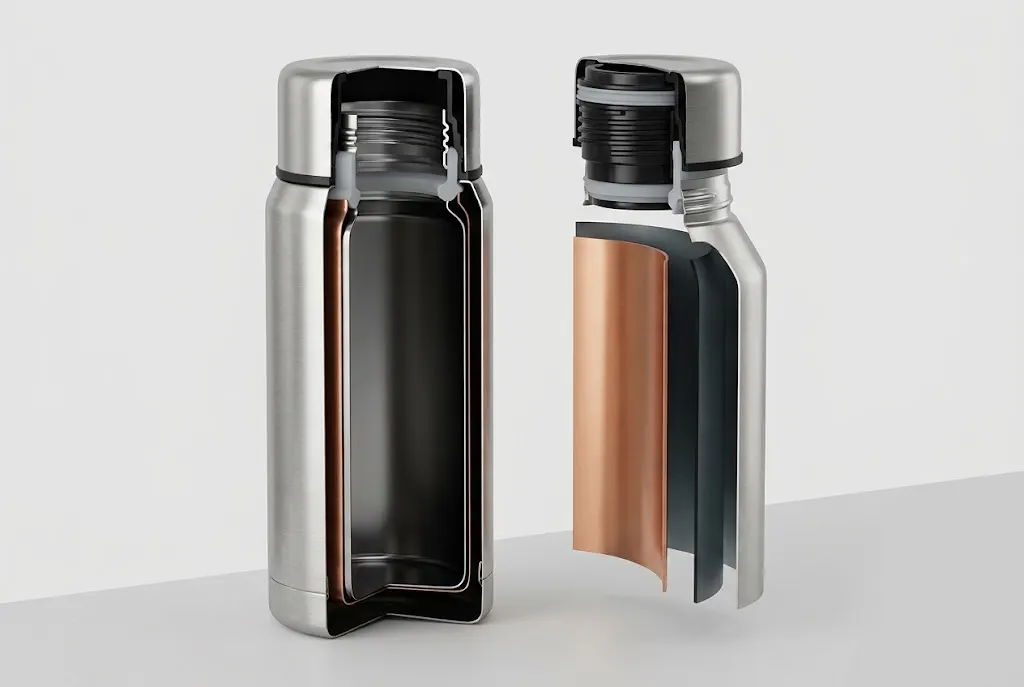
Table of Contents
- 1. Why Insulation Claims Are the Most Common Dispute in Thermos Sourcing
- 2. How Vacuum Insulation Actually Works — and Where It Fails
- 3. The Standards That Define “Heat Retention”
- 4. Realistic Performance Ranges — and How to Read a Claim
- 5. A Buyer’s Verification Protocol (Three Steps)
- 6. What Customer Reviews Can and Cannot Tell You
- 7. Does Logo Decoration Affect Insulation?
- 8. Matching Insulation Level to Use Case
- 9. Red Flags in a Supplier Quotation
- 10. Partner With Mofecup for Custom Thermos Bottles
1. Why Insulation Claims Are the Most Common Dispute in Thermos Sourcing
Custom thermos bottles and insulated tumblers are among the most common promotional and private-label drinkware products there are. They are also the category where the gap between the marketing claim and the delivered article is widest.
The claims are familiar: 24-hour heat retention, 36-hour cold insulation, all-day temperature control. The problem is that “24 hours” can be measured in several ways — from what starting temperature, at what ambient temperature, at what fill volume, and down to what final temperature? A claim without those parameters attached is not a specification. It is a slogan.
For a buyer placing a bulk order with a logo on it, the consequences land on your brand, not the factory’s:
- Negative reviews and product returns
- Damage to brand reputation that is far more expensive than the order
- After-sales cost and rework across an entire batch
- A promotional item that quietly undermines the message it was printed to carry
Insulation performance is also the hardest claim to verify after delivery, because by then the tooling is cut and the batch is on the water. Which is why the verification has to happen during sampling — using a defined method, and against a real standard.
2. How Vacuum Insulation Actually Works — and Where It Fails
A vacuum flask works on a simple principle: heat moves by conduction, convection and radiation, and the design has to block all three. The double wall handles conduction and convection. The vacuum gap eliminates the air that would otherwise carry heat across. A reflective or copper-plated layer inside the gap handles radiation.
That is why the construction — not the marketing copy — is what you should be inspecting. Regulations and standards for vacuum ware exist precisely because performance depends on whether the vacuum and the closures were actually made to spec, and the finished article has to be verified rather than assumed[1].
| Failure point | What goes wrong | How it shows up in use | What to ask for |
|---|---|---|---|
| Incomplete vacuum | Air remains in the gap; residual gas conducts heat | Warm outer wall; rapid early heat loss | Vacuum level held on the line, and lot-level leak testing |
| Thin or uneven vacuum layer | Wall spacing varies; part of the surface conducts directly | Hot or cold spots on the body | Wall thickness and gap tolerance on the drawing |
| Weak neck or bottom weld | Seam is the highest-stress point of the vacuum body | Performance degrades over months; fails after drops | Weld inspection and drop-test data, not a visual check |
| No radiant barrier | Radiation is a minor loss path, but it is still a loss path | Lower peak performance; larger gap to premium tier | Whether the vacuum layer is copper-plated — an option on premium tiers |
| Lid and seal leakage | Heat escapes through the opening, not the wall | Good wall insulation but poor real-world retention | Seal material spec and lid fit tolerances — see our notes on thread, gasket and seal engineering |
The last row is the one buyers most often overlook. A bottle can have a perfect vacuum body and still disappoint, because the lid is where heat leaves fastest. Our comparison of double-wall and triple-wall vacuum construction covers how the layered options differ, and our guide to lid options explains the closure types and their sealing behaviour.
3. The Standards That Define “Heat Retention”
If a supplier cannot name the standard their test data is based on, the number on the quotation is unverifiable. Two standards do most of the work in this category, and which one applies depends on where you sell — not on where the bottle is made.
| Standard | Scope | Where it matters |
|---|---|---|
| GB/T 29606 — Stainless steel vacuum cups[1] | Chinese national standard for stainless steel vacuum flasks and cups, covering construction and heat-retention requirements | Almost every China-based thermos programme is built against this. Ask for the test report citing it. |
| DIN EN 12546-1[2] | Materials and articles in contact with foodstuffs — insulated containers for domestic use. Part 1 specifies vacuum ware, insulated flasks and jugs | European retail and promotional programmes, and any buyer who needs a recognised European reference point |
| GB 4806.9[3] | China’s mandatory food safety standard for metal materials and products in contact with food | The material side of the same conversation — grade, migration limits and suitability for food contact |
What a usable test report must contain
A test report is only useful if it lets someone else reproduce the result. Before you accept a data sheet, check that it states:
- The standard and test conditions: starting water temperature, fill volume, ambient temperature and the time intervals measured.
- The outcome in numbers: the actual temperature held at each interval — not a rounded “(hot 12h)”.
- The article tested: capacity, construction and whether the tested sample is the same specification you are ordering.
- The laboratory and the date: an in-house report is acceptable for a first screen; third-party verification matters for retail claims.
- Batch traceability: which production lot the sample came from. A report for a prototype does not certify a mass-produced lot.
For how temperature-retention testing is carried out on finished articles, see our article on verifying temperature retention and vacuum insulation testing.
4. Realistic Performance Ranges — and How to Read a Claim
The table below shows the ranges normally quoted for well-made vacuum drinkware. Treat them as orientation, not as a substitute for the test report on your actual specification.
| Tier | Hot retention | Cold retention | Typical build |
|---|---|---|---|
| Standard vacuum bottle | ≈ 6–8 hours | ≈ 12 hours | Double-wall vacuum, 304 stainless, standard lid |
| Premium vacuum bottle | ≈ 8–12 hours | ≈ 24 hours | Copper-plated vacuum layer, 316 option, closer-tolerance lid and gasket |
| Claims above these ranges | Should be supported by a dated test report naming the standard, the conditions and the tested article — otherwise treat the number as marketing | — | |
The four parameters a claim must include to mean anything
- Starting temperature — “hot” usually means close to boiling; a claim that starts lower flatters the result.
- Fill volume and headspace — a nearly empty bottle retains heat for far less time than a full one. This is a legitimate difference, not a defect, but it must be stated.
- Ambient temperature — the same bottle performs differently in a 20 °C office and a 0 °C winter car.
- The final threshold — “12 hours hot” is meaningless without “…at or above what temperature?”
When a supplier cannot supply those four parameters, the honest reading is not that they are lying — it is that they have never measured. A factory that tests its output knows the numbers.
5. A Buyer’s Verification Protocol (Three Steps)
You do not need a laboratory to catch an exaggerated claim. You need a repeatable procedure, run on the sample you were actually sent — before the purchase order, not after.
Step 1 — Verify the construction, not the appearance
- ✔ Double-wall vacuum construction — confirmed by the wall build, not by the word “thermos”.
- ✔ Food-grade stainless steel — 304 as standard, 316 where corrosion resistance matters. Compare grades with our guide to 201, 304 and 316 stainless steel.
- ✔ Seamless inner wall — fewer seams means fewer leak paths and easier cleaning.
- ✔ Copper-plated vacuum layer — an optional premium feature; ask whether your specification includes it.
- ✔ Lid and gasket quality — often the real limit on retention.
Step 2 — Run the boiling-water test yourself
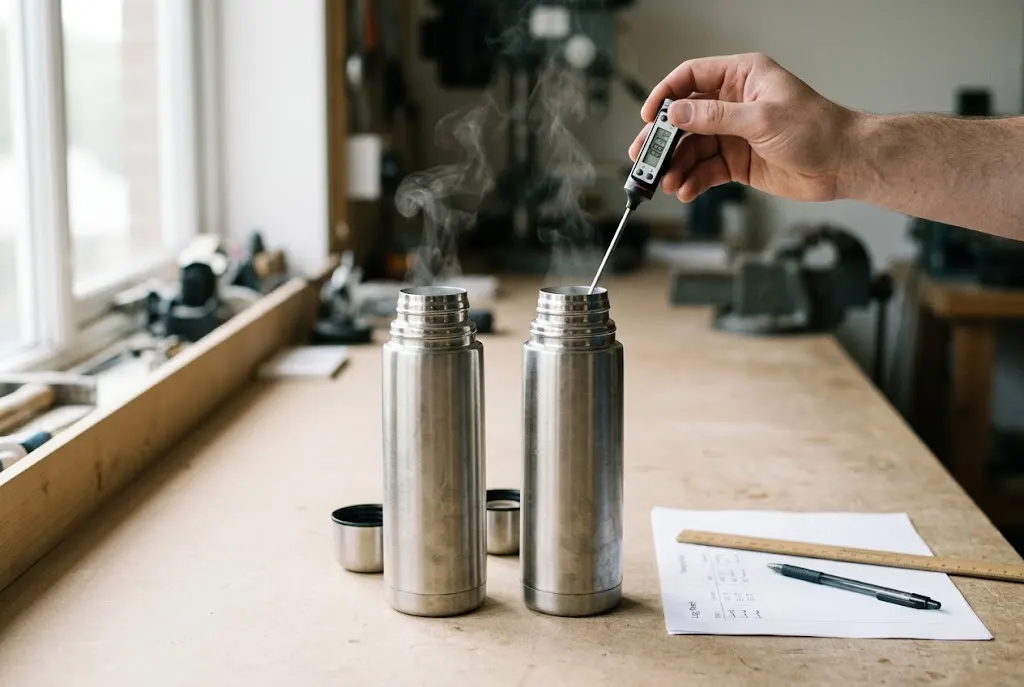
This is the quickest way to tell a real vacuum body from one that merely looks like one. Use at least two samples so a single defective unit does not distort the reading.
- Fill with freshly boiled water to the fill line, leave no more than minimal headspace, and close the lid fully.
- Record the starting temperature immediately with a probe thermometer.
- Keep the bottle at a stable ambient temperature. Do not open it between readings.
- Record the temperature at the intervals below, and log the ambient temperature each time.
| Interval | Reading (°C) | Drop from previous | Ambient (°C) |
|---|---|---|---|
| Start | — | ||
| 2 hours | |||
| 4 hours | |||
| 6 hours | |||
| 12 hours | |||
| 24 hours |
Two things make this test meaningful rather than decorative. First, the shape of the curve matters more than any single number — a well-made vacuum body loses heat steadily and slowly, while a defective one drops steeply in the first hour or two and then flattens out, because the loss is happening through the lid or a poor vacuum rather than the vacuum gap. Second, touch the outer wall: with boiling water inside, a functioning vacuum body stays cool to the touch. A warm outer wall is the clearest single warning sign available to a buyer without a lab.
Record the results alongside the supplier’s claimed figures. If the tested sample cannot reproduce the claim under your conditions, the claim does not exist on paper — it exists on a slide.
Step 3 — Evaluate a production sample, not a catalogue
Prototype and “golden sample” units are made carefully by definition. The question is whether the mass-production lot behaves the same way. Ask for a sample drawn from the actual production run, and repeat Step 2 on it. Pair this with the structural checks in our leak-testing standards for OEM drinkware, since vacuum loss and water ingress share several failure points.
6. What Customer Reviews Can and Cannot Tell You
Reading end-user reviews is useful, but only if you read them for the right thing. Reviews are good at revealing failure patterns over time and poor at confirming absolute performance figures.
| Reviews are reliable for | Reviews are unreliable for |
|---|---|
| Heat retention overnight, in a described real setting | Exact hours held — reviewers rarely control fill volume or ambient temperature |
| Dishwasher safety and how finishes age | Whether a specific defect is a design fault or a one-off unit |
| Lid leakage, smell retention and cleaning difficulty | Performance of your specification — reviews describe someone else’s build |
| Outdoor and travel use in cold or hot conditions | Anything about a pre-production or private-label variant that has no reviews yet |
The practical use of reviews is diagnostic: a recurring complaint about warm outer walls or overnight heat loss points to a vacuum-quality problem worth investigating in the factory, not a one-off. For dishwasher-related complaints specifically, see our guide to dishwasher safety for custom bottles.
7. Does Logo Decoration Affect Insulation?
In almost every case, no. Branding methods act on the outer surface and do not touch the vacuum gap or the inner wall, so they do not change thermal performance:
- Laser engraving — removes a thin surface layer; no thermal effect.
- Screen printing — thin ink film cured onto the surface.
- Powder coating — a cured polymer layer; adds durability and colour.
- UV and heat-transfer printing — surface decoration only.
Two honest caveats. First, exceptionally thick or heavy decorative coatings have, in rare cases, been associated with marginally reduced retention — a well-run factory specifies coatings that avoid this, so ask the question rather than assuming. Second, and more importantly, decoration introduces its own compliance layer: coatings, adhesives and inks that sit on a food-contact article fall under separate regulatory treatment from the steel itself. In the United States, coatings and adhesives are regulated as indirect food additives[4], and the wider food-contact framework for substances used on or in food-contact articles is set out by the FDA[5].
That means a decoration decision is also a documentation decision. For the surface finishes available and how they are specified, see our overview of custom surface finishing for drinkware, and for the testing that applies to coatings, seals and gaskets, our notes on VOC testing for sealants, gaskets and coatings.
8. Matching Insulation Level to Use Case
Over-specifying wastes budget; under-specifying creates reviews you cannot delete. The right question is not “what is the best bottle?” but “what does this programme actually need?”
| Use case | Recommended build | Why |
|---|---|---|
| Outdoor, travel and sports | Double-wall vacuum stainless, copper-plated layer, sealed lid | Longest hold times and best drop resistance; the use case justifies the premium tier |
| Corporate gifts and executive gifting | Premium insulated tumbler or flask, refined finish, gift packaging | Perceived quality matters as much as measured performance |
| Office and everyday commuting | Standard vacuum mug or tumbler, 304 stainless | Comfortable at the standard tier; avoids paying for capacity no one uses |
| Promotional giveaways at volume | Budget-friendly single-wall or light vacuum tumbler | Cost per unit dominates; do not claim long retention on this tier |
| Private label / retail | Specified tier with documented test reports and material certificates | Retail buyers and market surveillance will ask for the paperwork |
For retail and private label, the paperwork question is not optional. In the European Union, food-contact materials fall under the framework regulation on materials intended to come into contact with food[6]; in the United States, California’s Proposition 65 imposes separate lead-exposure requirements that a decorated drinkware programme has to consider[7]; and plastic components — lids, seals, gaskets — are treated as their own category of indirect food additives[8]. If “BPA-free” appears on your packaging, it should be supported by testing on the components in question — see our notes on BPA material safety testing.
9. Red Flags in a Supplier Quotation
Most of these appear before you have spent any money — which is exactly when they are cheapest to act on.
- A retention figure with no conditions attached. No starting temperature, no fill volume, no ambient, no final threshold.
- “Test report available” that never arrives. Ask for the document at quotation stage, not after deposit.
- The same retention numbers quoted across every capacity. A 350 ml and a 1,200 ml flask do not hold heat for the same duration by coincidence.
- Grade claimed but not documented. “304” is a specification; ask for the material test certificate. Grade substitution is a real and common problem, and the verification methods are covered in our stainless steel grade comparison.
- No answer on the vacuum layer. A factory that makes vacuum ware knows whether its line includes copper plating.
- Reluctance to supply a production-run sample. Prototypes are not evidence about mass production.
- Delivery promises that ignore decoration lead time. Firing, curing and coating add real time — and rushing them is how finish defects happen.
None of these is proof of bad faith on its own. Together, they are a reliable signal that the specification has not been thought through — and in thermos sourcing, an unspecified article is the expensive kind.
Mofecup produces custom thermos bottles, insulated tumblers and vacuum flasks for brands, corporate gifting and private label. We quote against a defined specification, provide retention test data and material certificates on request, and supply production-run samples before bulk orders so you verify performance rather than trust a figure. Send us your capacity, market and target price and we will come back with a costed specification. Request a quote →
10. Partner With Mofecup for Custom Thermos Bottles
Mofecup is a drinkware supplier working with brands, promotional distributors, corporate gifting programmes and private-label retailers. Our process is built around the point where thermos projects most often fail — the gap between what the catalogue promises and what the production line delivers:
- Specification before quotation. We define capacity, wall construction, steel grade, lid type and decoration route up front, so the retention figure has something to attach to.
- Retention test data and material certificates available on request, referenced to the standard applicable to your market.
- Production-run samples before bulk orders, so you can run your own hold test on the article you are actually buying.
- Double-wall vacuum construction in 304 stainless as standard, 316 where corrosion resistance or premium positioning calls for it, with copper-plated vacuum layers available on premium tiers.
- Full decoration set — laser engraving, screen printing, powder coating and UV printing, with the finish tested for dishwasher durability. See surface finishing options.
- Lid and closure engineering — screw, flip, push-button and straw configurations, matched to the retention target. Compare in our cap design guide.
- Food-contact documentation support for your target market, including migration testing where your market requires it — see food-contact migration testing.
Start from our overview of custom drinkware manufacturing, or send your brief directly and we will respond with a specification and a costed option for comparison.
Footnotes & References
[1] Standardization Administration of China. GB/T 29606 — Stainless steel vacuum cups (不锈钢真空杯). Current edition GB/T 29606-2013; a revised edition, GB/T 29606-2026, was published in January 2026 for implementation in February 2027. openstd.samr.gov.cn
[2] European Committee for Standardization (CEN) / Deutsches Institut für Normung (DIN). DIN EN 12546-1:2000 — Materials and articles in contact with foodstuffs: Insulated containers for domestic use. Part 1: Specification for vacuum ware, insulated flasks and jugs. webstore.ansi.org
[3] National Health Commission of the People’s Republic of China. GB 4806.9 — National food safety standard: Metal materials and products for food contact (食品安全国家标准 · 食品接触用金属材料及制品). Current edition GB 4806.9-2023. chinesestandard.net
[4] U.S. Electronic Code of Federal Regulations. 21 CFR Part 175 — Indirect Food Additives: Adhesives and Components of Coatings. ecfr.gov
[5] U.S. Food & Drug Administration. Packaging & Food Contact Substances (FCS) — regulatory framework for substances used in materials that contact food. fda.gov
[6] European Parliament and Council. Regulation (EC) No 1935/2004 on materials and articles intended to come into contact with food. eur-lex.europa.eu
[7] California Office of Environmental Health Hazard Assessment (OEHHA). Proposition 65 — Safe Drinking Water and Toxic Enforcement Act. oehha.ca.gov
[8] U.S. Electronic Code of Federal Regulations. 21 CFR Part 177 — Indirect Food Additives: Polymers (applies to plastic components such as lids, seals and gaskets). ecfr.gov