
One Unit, One Name, One Start Date
Sourcing Personalised Bottles for Welcome Kits
Table of Contents
- 1. A Welcome Kit Is a Procurement Problem, Not a Gifting Problem
- 2. The Four Constraints That Define the Order
- 3. Kit Architecture: What the Bottle Actually Does
- 4. The Personalisation Paradox: One Unit, Every Name Different
- 5. Engraved Names Are Irreversible — and That Is a Cost Line
- 6. A Name Is Personal Data: The Step Nobody Plans For
- 7. Specifications for a Welcome-Kit Bottle
- 8. Delivery Mechanics: Aligning to Start Dates
- 9. The Cost Model Behind a 200-Person Programme
- 10. What to Lock Before You Order
- 11. FAQ
- 12. Partner With Mofecup on a Welcome-Kit Programme
1. A Welcome Kit Is a Procurement Problem, Not a Gifting Problem
Employee welcome kits get discussed as a culture topic — first impressions, belonging, the message a company sends on day one. All of that is real. But the reason these programmes go wrong is almost never cultural. It is that the order structure behind a welcome kit is one of the hardest formats in custom manufacturing, and nobody treats it that way.
Consider what a welcome kit actually is as an order. A brand ordering 2,000 promotional bottles places one purchase: a single SKU, a single artwork, a single decoration setup, one delivery date. A company ordering 200 welcome kits places an order that shares almost none of those properties. Every unit is destined for a different person. Many need a different name on them. Each has to be in the right place on a specific date that the HR calendar sets and the new hire’s notice period controls.
In manufacturing terms that is high mix, low volume, hard deadline — the combination that costs the most and tolerates the least slippage. This article works through that structure honestly: what it does to tooling and unit cost, where the real lead-time risk sits, which personalisation routes are even viable at one unit per person, and what has to be settled before the first order rather than after.
Where this fits with our other guides
This article covers the order-structure layer — what one-unit-per-person personalisation demands and what it costs. Adjacent decisions live elsewhere:
Whether corporate drinkware pays for itself at all (market context, use cases, cost analysis) → ROI of custom drinkware in corporate gifting
Drinkware inside a wellbeing or engagement programme → corporate wellness programmes and employee engagement
Material and sustainability choices for corporate ranges → why customised glassware became a corporate standard · sustainable materials and packaging
How the logo or name is physically applied → logo application methods compared · laser engraving vs screen printing
Low-volume economics in general → whether small-batch customisation is really expensive
2. The Four Constraints That Define the Order
Four properties separate a welcome-kit order from a normal promotional order. Each of them individually is manageable. Together they define a procurement problem, and knowing which one is driving your cost tells you which lever to pull.
| Constraint | What it means as an order | What it does to cost or risk |
|---|---|---|
| One unit per person | No quantity break is reachable on the personalised element. Effective batch size is one. | Per-unit handling dominates; unit price is set by process, not by volume |
| Every unit potentially different | A separate data record, artwork file and verification step per piece | Error rate becomes a cost line, not an annoyance |
| Hard calendar dates | The deadline is a person’s first day, which is already fixed by the time the order is placed | There is no “delay the launch”. Late delivery means a kit arrives after the moment it was for |
| Distributed delivery | Kits go to offices, home addresses or a manager’s desk rather than one loading dock | Packing and carriage per destination, plus a tracking requirement you did not plan for |
A useful diagnostic: if a welcome-kit programme is over budget, check which of these four is actually driving it before renegotiating the unit price. Teams usually open with “can we get a better price on the bottle” when the real cost is the fourth row — packing and shipping to forty different destinations.
Why this differs from the standard corporate-gift order
A conventional corporate gift order is built to be efficient: one design, one quantity, one delivery, distributed internally after arrival. That is why gifting catalogues can quote low unit prices. A welcome kit is the same product purchased under the opposite conditions, and the price difference between those two scenarios is mostly process, not material. The ROI case for corporate drinkware and this article are therefore answering different questions — one asks whether to do it, this one asks how to place the order.
3. Kit Architecture: What the Bottle Actually Does
A welcome kit is a small product portfolio, and its parts fail in different ways. Apparel has a sizing problem — you either collect sizes in advance or carry a spread. Paper goods have a shelf-life and a printing minimum. A reusable bottle has neither: one specification suits everyone, it does not expire, and it is the item most likely to still be in use months later.
That is the honest case for putting the budget weight on the bottle. Not because a bottle is a more impressive gift, but because it is the only component with no sizing spread, no expiry and a plausible daily-use life. It is the part of the kit that does the work of being owned rather than received.
| Kit component | Operational weakness | Personalisation viability at one unit |
|---|---|---|
| Apparel | Sizing must be collected in advance or carried as a spread; fit is a complaint risk | Possible but adds a size dimension to every record |
| Notebooks and paper | Print minimums; low daily-use persistence; hard to personalise economically in small numbers | Weak — plate-based printing does not suit one-off names |
| Tech accessories | Short product cycles and compatibility questions; spec ages quickly | Varies by item; often minimum-order driven |
| Insulated bottle or flask | None structural — one spec suits all, no expiry, no sizing | Strong — digital marking applies a different name per unit with no plate change |
One caveat worth stating plainly, because it is the standard counter-argument: a bottle is not a high-visibility item the way a laptop sleeve or a jacket is, and it will not be seen by people outside the company as often as a backpack is. If the strategic goal is external visibility, the bottle’s contribution is modest by design. Its strength is internal and longitudinal — it is used in the office and at home, which is exactly the context a welcome kit operates in.
4. The Personalisation Paradox: One Unit, Every Name Different
This is the single decision that determines whether a welcome-kit programme is straightforward or painful, and it is usually made casually — someone suggests putting each new hire’s name on the bottle, everyone agrees it is a nice touch, and nobody checks whether the chosen decoration method can do it.
Because the answer depends entirely on the process. Every decoration method falls on one side of a line: does it require a physical plate, screen or tool that is specific to the artwork? If yes, a unique name per unit means a unique tool per unit. If no, the same equipment produces every variant and only the digital file changes.
| Method | Per-name viability at 1 unit | Why |
|---|---|---|
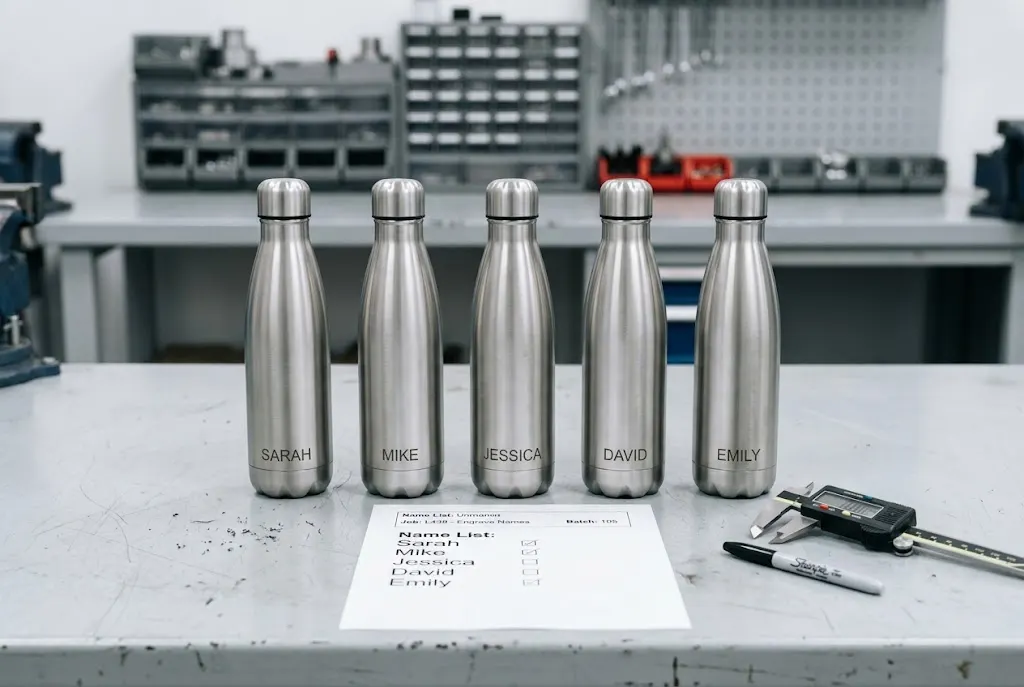
| Laser marking | Viable — the standard route for this job | Digital process: the artwork is a file, so each unit is a file change and nothing else |
| Screen printing | Not viable for individual names | Requires a screen per design; one-off personalisation would mean one screen per person |
| Engraved metal plate / badge | Possible, but adds a component per unit | A physical part must be produced, matched to a bottle and attached — three places to get it wrong |
| Printed label | Viable, but it is a label | Digital label printing handles variable data, but a label flakes, peels and reads as temporary next to engraved metal |
The practical consequence
If per-person names are part of the brief, the marking method is effectively decided: it has to be the digital one. The remaining question is what you engrave, and there is a real trade-off here.
Names personalise better; initials and company marks scale better. A first name makes the object personal, which is precisely the point of a welcome kit — but every unit becomes unique, which removes any possibility of using surplus stock for a future hire, a replacement, or an event. A company mark with a personal initial, or names reserved for a specific tier (say, permanent staff), keeps a reusable stock of unbranded units. Both are defensible strategies; what is not defensible is promising names and discovering at the tooling stage that the decoration route cannot deliver them.
The mechanical detail of each method, including how each behaves after repeated washing, is set out in laser engraving versus screen printing and our logo application methods guide.
5. Engraved Names Are Irreversible — and That Is a Cost Line
Personalisation is usually discussed as a value added to a product. In a welcome-kit programme it also creates a liability that does not exist in any other order type: a bottle with a person’s name on it cannot be reallocated.
Think through the scenarios. A hire accepts and then does not start. A name is spelled correctly in the HR system and incorrectly on the order sheet. A batch of twenty is produced and the start date moves by three weeks. In a normal promotional order, every one of these is absorbed by putting the unit back in stock. In a named order, each one is scrap — the unit has no other buyer, and it cannot even be given away discreetly.
| Scenario | Unnamed unit | Named unit | Mitigation |
|---|---|---|---|
| Offer declined before start | Returns to stock | Written off | Mark personalisation only after the start date is confirmed |
| Name misspelled in the order data | Not applicable | Written off — and now visible to the recipient | Two-person verification against a source of record; produce a proof sheet before the run |
| Start date moves after production | Holds indefinitely | Holds, but for that person only | Batch personalisation late; keep a small buffer of unnamed units |
| Spare units for future hires | Fully fungible | Impossible for the named portion | Split the order: named units to order, unnamed buffer held |
The mitigation everyone eventually arrives at is the same: hold a buffer of unnamed units and personalise to order, in small runs as start dates confirm. That reverses the usual instinct — personalise everything in one pass to save handling — and it is the right call, because it converts an unbounded scrap exposure into a bounded handling cost. The question worth asking a supplier is not “can you engrave names” but “can you engrave a run of fifteen, then another twelve, without re-tooling charges”. With a digital marking process the answer should be yes; that answer is the thing to verify before signing.
Where the mark sits matters for the same reason it matters in any branded programme: the more permanent and the better integrated the marking, the less it reads as an afterthought. Markings applied to metal surfaces are also subject to their own durability expectations, and decorative or coated surfaces have established abrasion-resistance test methods behind them[1]. Where a coating system sits on a surface the drink can reach, it falls under the indirect food-additive provisions for adhesives and coating components rather than being exempt because it is “just decoration”[6].
6. A Name Is Personal Data: The Step Nobody Plans For
Here is the part of welcome-kit personalisation that is almost never raised in a gifting conversation, and should be. The moment a programme involves collecting names and sending them to a supplier to be marked on an object, it stops being a procurement exercise and becomes a personal-data exercise.
In the European Union, the general data protection framework governs how personal data may be collected, used and transferred, and a person’s name is personal data[2][3]. That has practical consequences for a welcome-kit order that a promotional order does not have: the list of names you send to a supplier is a data transfer, the file has a lifecycle, and there is an expectation about how long it is kept and who can see it.
| Step | Why it deserves attention | Practical control |
|---|---|---|
| Collecting the names | Names arrive from an HR system that is already governed; copying them into a spreadsheet outside it is where control is lost | Keep the working list inside a controlled system; avoid emailing plain lists |
| Sending the list to the supplier | This is a disclosure to a third party, potentially outside the recipients’ jurisdiction | Agree in the contract what data is transferred, why, and for how long it is retained |
| Storing the artwork files | A folder of name files is a name database whether or not it was intended as one | Set a deletion date at the point of creation, not afterwards |
| The physical outcome | A scrap unit carries a real person’s name into a waste stream | Define how mis-marked units are destroyed rather than discarded |
Two honest qualifications. First, this is not a reason to avoid personalisation — it is a reason to plan it, and the controls above are ordinary administrative steps rather than specialist work. Second, the specific obligations depend on where your employees are and where your supplier is, and that is a question for whoever handles data protection in your organisation, not for a supplier to answer on your behalf. A drinkware supplier can tell you how marking works and what files are needed; it should not be giving you data-protection advice.
The simplest way to sidestep most of it is a design decision rather than a legal one: engrave initials or a company mark instead of full names. A single initial carries far less identifying information, still feels personal, and keeps the units closer to fungible. Where a programme’s whole intent is personal recognition, that trade-off may not be acceptable — but it should be a considered choice rather than a default.
7. Specifications for a Welcome-Kit Bottle
A welcome-kit bottle has one job the promotional version does not: it has to survive being used by one person, often daily, for long enough that it still means something. That shifts the specification in a few specific directions.
| Parameter | Working choice | Why it matters here |
|---|---|---|
| Capacity | 16–20 oz (approx. 470–590 ml) | Fits a desk, a commute bag and a car cup holder — the three places a work bottle actually gets used. Larger formats get left at home |
| Finish | Powder-coated or matte | Fingerprint-resistant, and it is the finish that reads as substantial in the hand. Colour and texture options are covered in finish guides and coating versus plating |
| Lid | One-handed opening; leak-proof when closed | A bottle that leaks in a bag gets retired in week one. Leak performance is a tested property, not a promise — see lid systems compared |
| Insulation | Double-wall vacuum; retention claim stated with its test conditions | Keeping a morning coffee hot through a first meeting is the use case — and the claim needs a method behind it, see retention testing. For supply from China, GB/T 29606 is the national standard covering vacuum flask insulation performance and structure[9] |
| Decoration | Small mark, low on the body, laser-applied | A large high-contrast logo dates the object and makes it read as merchandise. A small mark near the base does the same job without dominating the product |
| Body material | Stainless steel; destination-market food-contact compliance documented | An assembly, not a single material: inner wall, gasket, lid interior and coating are each separately regulated — metal components under China’s mandatory metal food-contact standard[8], polymer parts such as seals and lid interiors under the polymer provisions in the United States[7]. See migration testing and food-grade standards |
| Packaging | Presentable enough to hand over as a gift, protective enough to post individually | Often the most underestimated line item — see packaging and perceived value |
One specification that gets written down last and should be written down early: any environmental claim the kit makes — recycled content, recyclability, plastic-free — is a claim about the physical article, and in major markets environmental marketing claims are expected to be substantiated rather than aspirational[10]. Where a welcome kit is being marketed on its sustainability, the documentation has to exist before the wording does, and a claim that cannot be supported is worse than no claim at all.
On capacity specifically, there is a real tension. The 16–20 oz range is the analytical choice for a work context, and smaller formats are also cheaper to ship in individual parcels, which matters when kits disperse. But a large-format bottle photographs as a more generous gift, and if the kit’s main audience is internal communications rather than the recipient, that may dominate. Both are legitimate; the mistake is specifying 32 oz for a commuting desk bottle and then wondering why it stays at home.
8. Delivery Mechanics: Aligning to Start Dates
The date problem in a welcome-kit programme is structurally different from a normal order, and it is worth being precise about why. In a promotional order, the deadline is a campaign date the brand controls. In a welcome kit, the deadline is somebody else’s first day — set by an accepted offer, a notice period and a start date that HR has already communicated. Production cannot move it.
There are two operating models, and they have opposite weaknesses.
| Model | How it works | Strength | Weakness |
|---|---|---|---|
| Stock-and-personalise | Order a block of unnamed bottles once; mark names in small runs as start dates confirm | Unit cost benefits from a real volume order; short notice on any individual hire is survivable | Capital tied up in stock; storage; a format change strands remaining units |
| Order-to-hire | Place an order per batch of hires, aligned to their start dates | No dead stock; each run is exactly what is needed | Small quantities sit above volume break points; every run pays its own setup and shipping |
| Direct dispatch | Named kits shipped individually to office or home | Works for remote and multi-site hiring, which is now the common case | Per-parcel cost and tracking overhead; breakage in small parcels needs tested packing |
| Bulk-to-HQ | One shipment to a single site, distributed internally on day one | Cheapest carriage per unit; the kit is handed over in person, which is the point | Only works if the hire is on site on day one; requires internal storage and a distribution owner |
Most programmes end up hybrid, and the workable version is the first row combined with one of the last two: one consolidated bulk purchase at a real quantity break, then personalised runs as dates confirm, then dispatch by route depending on where each person actually is on day one. The reason to lead with the stock decision is that it is the only one that changes the unit price materially. Packing and carriage are real costs, but they are variable and predictable; the tooling and volume decision is the one that is hard to reverse.
Two mechanics worth settling early. First, who owns the list between order and dispatch — if HR provides names three weeks ahead but personalisation happens the day before start, someone has to hold and track a live list, and that responsibility is usually unassigned. Second, what happens on a late start: an accepted offer with a moved date produces a named unit with no immediate destination, which is exactly the scenario in section 5 and should have a written answer rather than an improvised one. Carton configuration for individual parcels is worth testing rather than assuming — a single bottle in a small box is a different drop event from a full case, and distribution simulation protocols exist for exactly this[4][5]. Packaging selection for individual shipment is covered in our transit durability guide.
9. The Cost Model Behind a 200-Person Programme
Rather than quote prices, it is more useful to show what varies, because the structure of the cost is what determines whether a programme is affordable. The figures below are an illustrative structure — put your own numbers into it.
| Cost line | Fixed or per-unit | What it responds to | Where programmes overspend |
|---|---|---|---|
| Bottle unit price | Per unit, banded | Total quantity in the block purchase, not the number of names | Buying in per-hire batches and never reaching a quantity band |
| Personalisation setup | Per run | How many separate personalisation runs you choose to do | Running names one at a time when a batch of twenty would do |
| File preparation and proofing | Per name / per run | Data quality — whether names arrive in a usable format or need manual cleaning | Handling names as free text instead of a structured list |
| Scrap and re-make | Per incident | Error rate in data entry and verification | No proof-sheet step and no second pair of eyes |
| Packaging per kit | Per unit, banded | Whether the box is presentation-grade or protective-only, and whether it ships alone | Specifying gift-grade presentation for kits that ship individually to homes |
| Freight and last-mile | Per destination | Number of distinct addresses, not number of kits | The line most often left out of the business case entirely |
| Internal handling | Per hour | How much of the list management, storage and distribution falls in-house | Assuming it is free because it is not invoiced |
The pattern: the bottle is the visible cost, and it is usually the one with the least room to move. The lines that vary most between a well-run programme and a badly run one are personalisation setup, scrap, and freight — which are all consequences of how the order was structured rather than of what the bottle costs. That is why the useful move is not to negotiate the unit price first, but to consolidate the block purchase, batch the personalisation, and count the destinations before committing to a delivery model.
One number that is worth calculating and is often skipped: cost per new hire, including internal handling time. Two programmes with identical bottles can differ substantially on that figure because one batches personalisation and one does not. It also gives you the comparison that actually matters for a budget conversation — against the cost of recruitment, rather than against a promotional catalogue.
10. What to Lock Before You Order
Everything above reduces to a short list. Each item is cheap to decide now and expensive to discover later.
| Decide | The question that settles it | Cost of getting it wrong |
|---|---|---|
| What gets personalised | Full name, initial, or company mark only? | Choosing a method that cannot deliver the brief |
| Marking method | Is the process digital, or does it need a plate per design? | Per-name tooling that makes the programme unaffordable |
| Named versus unnamed split | How large a buffer of unnamed units do you want to hold? | Every cancelled hire becomes a written-off unit |
| Order structure | One block purchase, or a batch per hire group? | Paying above every quantity break |
| Data handling | Who owns the name list, and when is it deleted? | An unmanaged data set and an undefined disclosure |
| Verification step | What is checked against what, and by whom, before marking begins? | A misspelled name delivered to the person it belongs to |
| Delivery model | How many destination addresses, and who pays for them? | A freight bill larger than the business case assumed |
| Lead time buffer | How many days ahead of the earliest start date does the order need to be placed? | A kit arriving after the day it was meant for |
| Reference sample | Which physical pieces define “correct” for reorders? | A second batch that does not match the first |
Most of this is settled at sampling, and sampling is the cheapest place to change your mind. Our sampling process guide covers what a useful sample round should produce; the ordering mechanics — quantity bands, lead times and payment terms — are set out in MOQ, lead time and payment terms and our B2B ordering guide; and the underlying low-volume economics in small-batch customisation.
11. FAQ
Can you put a different name on every bottle in a welcome kit?
Yes, and it is done routinely — but only with a digital marking process. Laser marking reads the artwork as a file, so changing the name between units is a file change with no tooling implication. Plate-based methods cannot do it economically, because each unique name would require its own screen or plate. So the practical answer is: names are achievable, and the choice of marking method is what makes them achievable. Confirm which process your supplier uses for the personalised element before promising names to anyone.
What is the minimum order for personalised bottles?
The personalised step has no meaningful minimum when it is digital, but the bottle itself does. The workable structure is to buy the bottles as one block at the best quantity you can justify, then personalise in small runs as start dates confirm. That way the quantity bands apply to the block purchase — where they actually save money — rather than to each individual name, where they cannot. Trying to hit a minimum with the personalised step alone is the mistake that makes welcome-kit orders look expensive.
What happens if a hire cancels after the bottle has been engraved?
The unit is a write-off. A bottle with a person’s name on it has no other recipient and cannot be reallocated, which is why the recommended structure is to hold a buffer of unnamed units and personalise as late as the schedule allows. That converts an open-ended scrap exposure into a bounded handling cost. It is worth agreeing a written answer to this scenario with your supplier rather than negotiating it case by case after it happens.
Is engraving employees’ names a data-protection issue?
It can be, because a name is personal data and sending a list of names to a supplier is a disclosure to a third party. The obligations depend on where your employees are and where the supplier is, which is a question for whoever handles data protection in your organisation rather than for a drinkware supplier. Practically, the controls are ordinary: keep the working list inside a controlled system rather than in email, agree what is transferred and how long it is retained, set a deletion date for the artwork at the point of creation, and decide how mis-marked units are destroyed. Choosing initials instead of full names reduces the exposure and is a design decision rather than a legal one.
What size bottle works best for a welcome kit?
For a work-context kit, 16–20 oz (roughly 470–590 ml) is the range that gets used: it fits a desk, a bag and a cup holder. Larger formats photograph as more generous gifts but tend to be left at home, which defeats the purpose of an item meant to be carried. Smaller formats also cost less to ship when kits dispatch individually, which matters in a dispersed programme. The right answer depends on whether the kit is primarily for the recipient or for the internal communications around it — both are legitimate, but they point to different sizes.
How far in advance should a welcome-kit order be placed?
Work backwards from the earliest start date, not forwards from today. The chain runs from bottle production through personalisation, packing and dispatch, and each stage has its own lead time; the personalisation stage is short when it is batched but not instantaneous, and individual dispatch adds transit time per destination. The useful exercise is to write that chain down with real numbers and a buffer, then compare it to your earliest confirmed start date. Programmes that fail on timing usually fail because the order was placed against a campaign instinct rather than a start-date calculation.
Does a branded bottle in a welcome kit actually make a difference?
Honestly, less than the gifting industry implies and more than a purely functional reading suggests. A bottle does not create belonging, and no single item in a kit will. What it can do is be one of the few kit items with no sizing spread, no expiry and a plausible daily-use life, so it is still present months later when the pens and the notebook are not. That is a modest, testable claim: track how many recipients still have it at six months. The stronger arguments about visible return — whether the kit repays its cost — belong to the programme-level case rather than the bottle.
Should the logo be large or small on a welcome-kit bottle?
Small, and low on the body. The reasoning is about longevity rather than modesty: a large high-contrast logo reads as merchandise, and merchandise gets treated as merchandise. A restrained mark near the base still identifies the item but leaves the product looking like a product rather than a campaign asset, which is what makes it acceptable to carry to a client meeting or keep on a desk for years. If visibility to outsiders is the actual objective, a kit item is a weak vehicle for it and the budget is better spent elsewhere.
Running a welcome-kit or on-boarding programme and want the numbers before you commit?Tell Mofecup your annual hire volume, the destinations, and whether names or initials are needed, and we will come back with a structured proposal rather than a single price: the block quantity that puts you in a sensible price band, the marking method that supports per-person names, how many personalisation runs your schedule implies, a proof-and-verification step so a misspelled name never reaches production, the retention and food-contact documentation for each material in the assembly, and tested packing for kits that ship individually. We will also tell you plainly when a spec you have been asked for is not worth its cost at your volume. Request a quote →
12. Partner With Mofecup on a Welcome-Kit Programme
Mofecup produces custom insulated bottles and drinkware for corporate gifting programmes, HR and on-boarding teams, promotional distributors and private label. On a welcome-kit programme our role is to make a one-unit-per-person order behave like a manageable one — which mostly means splitting the order correctly rather than discounting it.
In practice that means:
- A block purchase at a real quantity band, with personalisation run separately — so the volume discount lands where it is earned.
- Digital marking for per-person names or initials, so there is no per-name tooling and no minimum on the personalised step — see laser engraving versus screen printing.
- A proof-and-verification step before marking begins, because a misspelled name on a named unit cannot be recovered.
- A named-versus-unnamed split that keeps a buffer of fungible units against cancelled offers and late start dates.
- A finish and size specified for the desk rather than the catalogue — see finish options and colour matching.
- Component-level food-contact documentation for the assembly — inner wall, gasket, lid interior and coating, for the markets the kits are used in.
- Tested packing for individually dispatched kits, not only for bulk cartons — see transit durability testing.
- A costed model for the volume you actually hire, including the lines most often left out of the business case.
For the wider programme context, the commercial case for corporate drinkware sits in corporate gifting ROI, and drinkware inside a wellbeing programme in wellness and engagement programmes. Material selection across applications is in our materials by application guide. Or send your brief and we will respond with the structure, the specification and the costed options.
Footnotes & References
[1] ASTM International. ASTM D5264 — Standard Practice for Abrasion Resistance of Printed Materials by the Sutherland Rub Tester. A test method for evaluating how printed or coated surfaces resist abrasion — the method behind a durability claim on a decorated surface. astm.org
[2] European Commission. Data protection — the Commission’s overview of the EU legal framework for personal data, including the General Data Protection Regulation and how it applies to the collection, use and transfer of personal data. commission.europa.eu
[3] European Data Protection Board. EDPB — the independent European body that contributes to the consistent application of data protection rules across the EU and issues guidelines on their interpretation. edpb.europa.eu
[4] ASTM International. ASTM D4169 — Standard Practice for Performance Testing of Shipping Containers and Systems. A distribution simulation protocol used to qualify a shipping configuration against a defined sequence of handling and transport hazards — applicable to individually dispatched kits as well as bulk cartons. astm.org
[5] International Safe Transit Association (ISTA). ISTA test protocols for packaged-product performance. A series of transit test procedures commonly used alongside ASTM D4169, including protocols for small parcel distribution environments. ista.org
[6] U.S. Electronic Code of Federal Regulations. 21 CFR Part 175 — Indirect food additives: Adhesives and components of coatings. Governs substances used as components of adhesives and coatings on food-contact articles, relevant to decorated and coated bottle surfaces. ecfr.gov
[7] U.S. Electronic Code of Federal Regulations. 21 CFR Part 177 — Indirect food additives: Polymers. Governs polymer substances used in food-contact articles — the framework relevant to lid bodies, seals and gaskets on a reusable bottle. ecfr.gov
[8] National Health Commission of the People’s Republic of China. GB 4806.9 — National food safety standard: Metal materials and articles in contact with food (食品安全国家标准 · 食品接触用金属材料及制品), a mandatory standard in the GB 4806 series for food-contact materials. chinesestandard.net
[9] Standardization Administration of the People’s Republic of China. GB/T 29606 — Stainless steel vacuum flask (不锈钢真空杯). The national standard covering insulation performance and structural requirements for stainless steel vacuum flasks and bottles; searchable on China’s official standards platform. openstd.samr.gov.cn
[10] U.S. Federal Trade Commission. Guides for the Use of Environmental Marketing Claims (“Green Guides”) — codified at 16 CFR Part 260. Sets out the Commission’s guidance on substantiating environmental marketing claims, which applies to any sustainability statement printed on a kit or its packaging. ecfr.gov