Coffee Cup Design Trends 2026
From Trend to Tooling: What Brands Need to Specify
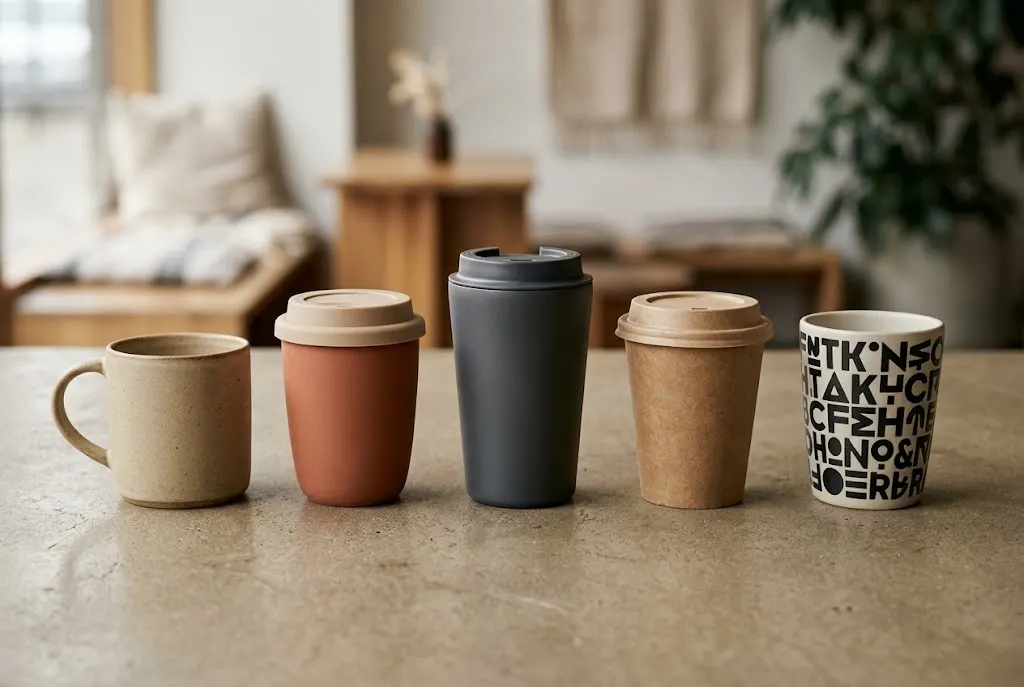
Table of Contents
- 1. Why Cup Design Is Now a Sourcing Decision
- 2. Trend 1 — Sustainable and Recyclable Cup Materials
- 3. Trend 2 — Minimalist Design: Matte Glazes and Neutral Palettes
- 4. Trend 3 — Bold Typography and Message-Driven Cups
- 5. Trend 4 — Illustration-Led and Pattern-Heavy Cups
- 6. Trend 5 — Local Culture and Limited-Edition Collections
- 7. Bonus Trend — Interactive and Colour-Changing Cups
- 8. Which Decoration Method Matches Each Trend?
- 9. Compliance Checklist Before You Commit to Tooling
- 10. Partner With Mofecup for Your Custom Coffee Cup Program
1. Why Cup Design Is Now a Sourcing Decision
In specialty coffee, the cup is no longer just a container. It is the surface a customer holds for ten minutes, the object photographed on the table, and — increasingly — the piece of brand merchandise that travels home with them.
That shift has a consequence most design conversations miss: every aesthetic decision on a cup is also a manufacturing decision. A matte glaze changes which decoration methods will adhere. A full-colour illustrated wrap changes how many print stations you pay for. A limited-edition city collection changes your order quantity, and therefore your unit cost.
Below are the five directions shaping coffee cup design in 2026, plus a bonus category — each followed by what it actually means for your specification, your tooling and your MOQ. If you are sourcing cups for a coffee brand, a roastery, a café group or a hotel programme, this is the translation layer between the trend deck and the purchase order.
2. Trend 1 — Sustainable and Recyclable Cup Materials
Sustainability remains the single strongest force in coffee packaging, and it now operates on two fronts at once: reusable serveware inside the café, and recyclable or compostable takeaway formats. Research on reusable cup promotion has shown that messaging, availability and small financial incentives all measurably shift customer behaviour toward reusables[1]. That is why reusable programmes have moved from short-lived pilots to standing features of café operations.
For a brand, the practical question is not “is this material sustainable?” but “can I substantiate the claim I put on the packaging?” The table below maps each format to what you should actually request from a supplier.
| Format | Typical construction | Best for | What to verify |
|---|---|---|---|
| Reusable ceramic mug | Stoneware or porcelain body, food-safe glaze | In-café service, retail sets, gift programmes | Lead and cadmium migration report; dishwasher-cycle durability |
| Insulated ceramic / double-wall | Two ceramic walls, glazed interior | Premium retail, gift-with-purchase | Thermal shock resistance; weight vs breakage in transit |
| Reusable stainless tumbler | 305/304-grade stainless body, double-wall vacuum | On-the-go customers, brand merch, travel ranges | Material test certificate per shipment — not per order |
| Recyclable paper cup | Certified board plus PE, aqueous or bio-based coating | High-volume takeaway service | Fibre certification chain of custody; which coating, and its recyclability evidence |
| Compostable fibre cup | Bagasse or moulded plant fibre, lined | Events, pilots, markets with collection infrastructure | Compostability certificate and the conditions it assumes; shelf life |
The specification trap in this trend
“Recyclable” and “compostable” are properties of the whole item, not of the fibre alone. A cup made of certified board but lined with a conventional polyethylene film may not be recyclable in your customers’ local stream. Likewise, a compostable claim is normally tied to a specific standard and a specific set of disposal conditions[2]. Before artwork is signed off, ask your supplier for the coating specification in writing and treat any claim you cannot document as a claim you cannot print.
If your programme leans toward reusable serveware instead, our guide to custom drinkware for hotel and hospitality brands covers how multi-site operators standardise reusable ranges across locations.
3. Trend 2 — Minimalist Design: Matte Glazes and Neutral Palettes
Minimalism continues to dominate specialty coffee identity, drawing on Japanese and Scandinavian restraint: clean silhouettes, restrained colour, one confident mark, and a tactile surface. The 2026 palette clusters around sand, clay, charcoal and soft cream, with matte glazes replacing high-gloss finishes almost everywhere.
The logic is commercial as well as aesthetic: a quiet cup lets the coffee stay the hero, and it photographs consistently — which matters when your packaging and social feed need to look like one brand.
What this trend costs you in production
- Matte glazes show wear more readily. Cutlery marks, coffee oils and hard water can leave traces on an unglossy surface. Specify a dishwasher-cycle test before you approve the finish — standards such as EN 12875 exist specifically to measure the mechanical dishwashing resistance of utensils[3].
- Some glazes reject decoration. Fired-on ceramics and matte reactive glazes can behave differently with organic screen-print inks versus decals. Always test your chosen artwork on the actual glaze batch — not on a generic sample mug.
- Neutral colours are harder to match than they look. “Sand” across a ceramic body, a kraft lid and a printed mailer can drift into three different tones. Fix a Pantone reference for the non-ceramic items and accept that the fired ceramic will be close, not identical.
For a method-by-method breakdown of how these finishes behave in production, see custom ceramic mug printing techniques compared.
4. Trend 3 — Bold Typography and Message-Driven Cups
Where minimalism removes detail, this trend adds voice. Brands are skipping complex illustration in favour of large text: oversized slogans, handwritten lettering, seasonal messages and in-jokes aimed at the regulars. It is cheap to recognise, easy to share and highly memorable — and it is one of the few design directions that gets cheaper to manufacture as it gets bolder.
What this trend costs you in production
- Solid, single-colour type is the friendliest artwork there is. One colour means one screen and one print station — the lowest setup cost of any decoration route.
- Thin script is a risk. Hairline strokes and small letterforms can break up or fill in during printing. Keep critical text comfortably above the minimum stroke width your supplier confirms, and avoid fine script below roughly 3 mm cap height without a print trial.
- Seasonal copy means short runs, and short runs cost more per unit. A rotating message programme is really a series of small orders. Plan the total annual volume with one supplier and schedule releases inside it, rather than ordering each drop separately.
- Check readability on the curved surface. A layout that works flat can wrap awkwardly. Ask for a curved-surface proof or a wrapped rendering before tooling.
For a side-by-side of the methods most suited to text-led artwork, see pad printing vs heat transfer vs UV direct print and our overview of custom logo printing.
5. Trend 4 — Illustration-Led and Pattern-Heavy Cups
Running alongside minimalism — often in the same city — is a strong counter-current of expressive graphics: hand-drawn illustration, geometric pattern, bright colour and playful iconography. For independent cafés competing for attention, a bold cup functions as a portable billboard carried through the neighbourhood.
What this trend costs you in production
This is the direction where artwork complexity and manufacturing cost are most tightly linked, so it deserves the most care up front:
- Every colour is a cost line. In screen printing, each ink colour generally requires its own screen and pass. A five-colour illustration is not five times the work of a one-colour mark, but it is a materially larger setup. Ask for a per-colour breakdown before approving the artwork, and consider reducing colours deliberately rather than by accident.
- Gradients and photographic detail need a different method. Continuous-tone artwork generally points toward decal-based or digital decoration rather than flat-colour screen printing.
- Wraparound artwork must be pre-distorted. Printing onto a cylinder or a tapered body means flat artwork will look stretched when applied. Supply vector artwork and confirm the dieline and taper compensation with the factory.
- Plan the seam. A 360° wrap has a start and end point, and on a handled mug the handle interrupts it. Decide where the seam sits — conventionally the back — at the design stage, not after the proof.
6. Trend 5 — Local Culture and Limited-Edition Collections
Location-specific design is one of the fastest-growing cup directions: city skylines, neighbourhood references, local landmarks, seasonal windows and event tie-ins. The commercial appeal is that the cup stops behaving like packaging and starts behaving like merchandise — something customers keep, collect and photograph.
What this trend costs you in production
- Limited editions have the worst unit economics of any trend here. A fired-in, multi-colour print across a small run spreads its setup cost over very few units. If the design is genuinely limited, either accept the higher unit price or move the differentiation to a cheaper variable layer.
- Use a shared blank plus a variable layer. A common approach is one decorated or undecorated base cup with a short-run element — a printed sleeve, a sticker, a hang tag, a coaster — carrying the location or season. You gain versioning flexibility without repeating the expensive step.
- Treat the packaging as part of the product. If the cup is a collectible, the box it arrives in is part of the perceived value. Our custom drinkware packaging guide covers the structural and print choices this involves.
- Watch rights and clearance. Landmarks, artworks, team marks and even some localised phrases can carry licensing or cultural-sensitivity considerations. Confirm usage rights before the design is finalised, not after.
7. Bonus Trend — Interactive and Colour-Changing Cups
The emerging direction worth watching is interactivity: graphics that appear when the cup is filled with a hot drink, and cups that link to a brand story through a printed code. Heat-sensitive ink technology is well established in packaging, and the surprise effect is a genuine differentiator in a café where most cups look alike.
It is also the trend with the most caveats, and they are worth stating plainly.
- Keep the ink away from the food-contact surface. Functional and colour-changing inks belong on the outside of the vessel. If any functional additive could conceivably migrate, it falls under the food-contact framework of your target market and needs a documented assessment[4]. In the United States, coatings and adhesives used on food-contact articles are regulated separately as indirect food additives[5].
- Performance is finite — set expectations with your own team. Colour-change coatings are surface technologies and will degrade with repeated washing and abrasion. Decide whether the item is a keepsake at room temperature or something expected to survive hundreds of dishwasher cycles, then specify accordingly.
- A printed code lives or dies on print durability. A QR code that scuffs off after two washes sends customers nowhere. Specify the code’s print method and abrasion requirement at the same time as the artwork.
- Interactivity should earn its cost. If the payoff is a generic landing page, the mechanism adds cost and complexity for little return. Design the destination before you design the ink.
8. Which Decoration Method Matches Each Trend?
Once the direction is chosen, the decoration method becomes the main cost and durability driver. The table below is a starting orientation — your supplier should confirm the specifics against your actual body material and artwork.
| Method | Colour capability | Durability | Setup cost | Suits |
|---|---|---|---|---|
| Screen printing (ceramic, fired) | Flat spot colours, typically 1–4 | Very high — fused into the glaze | High (one screen per colour) | Trend 3 — typography |
| High-temperature decal | Full colour, gradients, fine detail | Very high — fired onto the body | High (artwork separation & firing) | Trends 4 & 5 — illustration, editions |
| Pad printing | 1–2 spot colours | Medium | Low to medium | Small marks, lids, bases |
| Laser engraving (metal) | Monochrome, tone-on-tone | Very high — permanent mark | Medium | Trend 2 — minimal silverware |
| Vacuum coating (PVD, metal) | Metallic and solid tones | High — hard wearing | High | Trends 2 & 4 — colour bodies |
| Digital / heat transfer | Full colour, photo-real | Medium | Low (no screens) | Trend 4 at small volume |
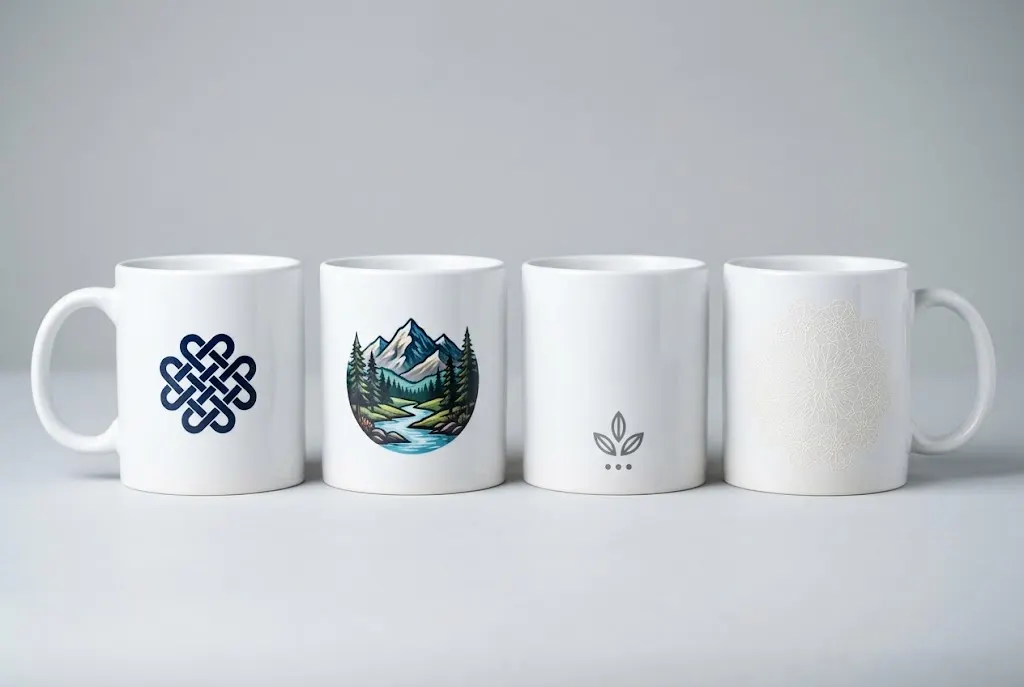
Two questions to ask on every quotation, regardless of method: how many print stations does this artwork require, and what is the tested durability claim. A quote that omits both is not yet comparable with the alternatives. On stainless ranges, the same comparison is covered in our article on laser engraving versus screen printing.
9. Compliance Checklist Before You Commit to Tooling
Trend decisions become irreversible the moment tooling is cut. Food-contact compliance is the area where that irreversibility bites hardest, because the controlling requirement depends on the market you sell into, not on where the cup is made.
| Market | Framework | What to request from your supplier |
|---|---|---|
| United States | FDA food-contact framework for food-contact substances[4]; California Proposition 65[6] for lead exposure | Migration or composition statement covering the decoration and the glaze, not only the base material |
| European Union | Regulation (EC) No 1935/2004[7] (framework); Directive 84/500/EEC[8] for ceramic articles | Lead and cadmium migration test report for ceramics — for cups and mugs the directive’s hollow-article limits apply — plus a declaration of compliance |
| Germany | LFGB together with the BfR recommendations for food-contact materials | LFGB-conformity documentation if you retail in the German market |
| All markets | Test methods for ceramic release of lead and cadmium | A report naming the test method used, the laboratory, and the batch or article tested[8] |
| Fibre and paper | Forest certification and compostability standards where claimed | Chain-of-custody certificate for the board[9]; the specific standard behind any compostable claim |
| Any approach | Practical durability | Dishwasher-cycle and thermal-shock test data for the finished decorated article |
For how these tests are actually performed and what the reports should contain, see food-contact migration testing for custom drinkware.
Mofecup produces custom ceramic mugs, tumblers and reusable cups for coffee brands, roasters and hospitality groups. We can quote per decoration method, confirm the food-contact documentation your market requires, and support low-volume first runs before you scale. Send us your artwork and target market and we will come back with a method recommendation and a costed option. Request a quote →
10. Partner With Mofecup for Your Custom Coffee Cup Program
Mofecup is a drinkware supplier working with coffee brands, roasteries, café groups, hospitality operators and promotional buyers worldwide. Our process is built around the point where most cup projects go wrong — the handover between the design deck and the factory:
- Method recommendation before quotation. We tell you which decoration route fits your artwork and volume, including the trade-offs, before you commit to tooling.
- Ceramic, stainless and reusable ranges under one programme, so a café, retail and merchandise line can share an identity.
- Decoration across the full method set — fired screen print, high-temperature decals, pad printing, laser engraving and vacuum coating.
- Food-contact documentation support for your target market, with test reports and material certificates available on request.
- Sampling and low-volume first runs for seasonal and limited-edition drops, so a small release does not require a large commitment.
- Custom packaging and gifting for collectible sets — see our packaging guide.
Explore the cup and mug range in our cup catalogue, read how we build drinkware programmes for coffee and tea brands and e-commerce and merchandise brands, or start from our overview of custom drinkware manufacturing.
Footnotes & References
[1] Poortinga, W. & Whitaker, L. (2018). Promoting the Use of Reusable Coffee Cups through Environmental Messaging, the Provision of Alternatives and Financial Incentives. Sustainability, 10(3), 873. doi.org/10.3390/su10030873
[2] ASTM International. ASTM D6400 — Standard Specification for Labeling of Plastics Designed to be Aerobically Composted in Municipal or Industrial Facilities. astm.org
[3] European Committee for Standardization (CEN). EN 12875 — Mechanical dishwashing resistance of utensils. Parts 1–4 cover reference test methods for domestic articles and rapid tests for ceramic and glass articles.
[4] U.S. Food & Drug Administration. Packaging & Food Contact Substances (FCS) — regulatory framework for substances used in materials that contact food. fda.gov
[5] U.S. Electronic Code of Federal Regulations. 21 CFR Part 175 — Indirect Food Additives: Adhesives and Components of Coatings. ecfr.gov
[6] California Office of Environmental Health Hazard Assessment (OEHHA). Proposition 65 — Safe Drinking Water and Toxic Enforcement Act. oehha.ca.gov
[7] European Parliament and Council. Regulation (EC) No 1935/2004 on materials and articles intended to come into contact with food. eur-lex.europa.eu
[8] Council of the European Union. Council Directive 84/500/EEC on ceramic articles intended to come into contact with foodstuffs (lead and cadmium migration limits, including those for hollow articles such as cups and mugs). eur-lex.europa.eu
[9] Forest Stewardship Council (FSC). Chain of custody certification for forest-based products. fsc.org