Copper vs. Stainless vs. Ceramic Bottle Liners
Which Inner Surface Is Right for Your Brand?
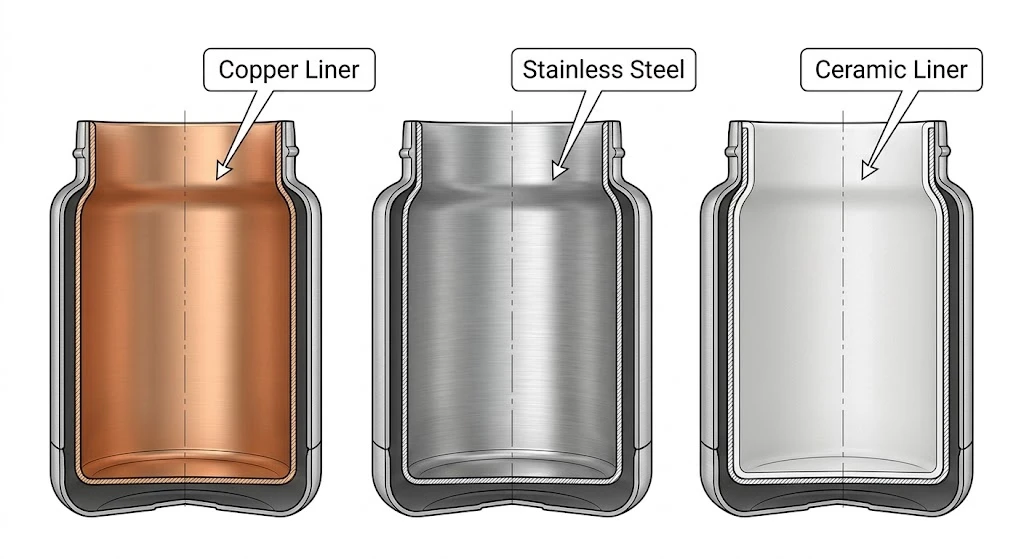
Table of Contents
- 1. Three Inner Surface Options Explained
- 2. Side-by-Side Comparison Table
- 3. Copper Liners: Claims, Benefits & Safety Reality
- 4. Stainless Steel: The Proven Default
- 5. Ceramic Liners: Taste & Premium Positioning
- 6. Decision Matrix for Your Brand
- 7. Partner With Mofecup
1. Three Inner Surface Options Explained
The inner surface of a water bottle — the material your customers’ drinks actually touch — is a decision many brands overlook. Yet it directly affects taste, safety, durability and even the premium story you can tell. For custom drinkware, the three main liner options are copper, stainless steel and ceramic.
Each has a different trade-off between performance, cost, and marketing appeal. Understanding the engineering reality behind the marketing claims will help you avoid sourcing mistakes — and help your sales team answer tough buyer questions[1].
2. Side-by-Side Comparison Table
| Property | Copper Liner | Stainless Steel (304/316) | Ceramic Liner |
|---|---|---|---|
| Heat retention | Good — vacuum layer does the real work; copper wall adds fast heat pickup | Excellent — proven 12-24h retention ✅ | Good, but ceramic adds weight and wall thickness |
| Taste neutrality | Depends on coating; raw copper can give metallic taste | Neutral when undamaged ✅ | Most neutral — no metallic taste ✅ |
| Safety / leaching | ⚠️ Needs food-grade inner coating; copper ions can leach into acidic drinks | Food-safe, low migration (304/316) ✅ | Inert, non-reactive ✅ |
| Durability | Good, but coating can wear over time | Very durable, dent-resistant ✅ | ⚠️ Prone to chipping/cracking on impact |
| Weight | Similar to steel | Baseline | Heavier ✅ |
| Cost | Premium (copper + coating + process) | Baseline (most economical) ✅ | Premium (ceramic coating process) |
| Marketing appeal | High — “copper health” story sells | Neutral — expected standard | High — “ceramic taste” premium story ✅ |
3. Copper Liners: Claims, Benefits & Safety Reality
Copper-lined bottles are popular in the premium segment, largely because of the widely circulated “copper water” health story. Here is what the engineering reality says:
3.1 The antimicrobial claim has some basis
Copper and its alloys are registered with the U.S. EPA as antimicrobial materials that kill 99.9% of certain bacteria on contact — but this registration applies to solid copper surfaces, not to thin liners inside bottles, and it says nothing about human health benefits[2]. Use this claim carefully in marketing.
3.2 The critical safety point: inner coating
Bare copper reacts with acidic beverages (fruit juices, tea, coffee), releasing copper ions into the drink. The World Health Organization sets a guideline value of 2 mg/L for copper in drinking water, and prolonged high intake can cause gastrointestinal irritation[3]. Reputable copper-lined bottles therefore apply a food-grade inner coating (e.g. food-safe lacquer or electroplated layer). Always verify the coating is food-contact certified.
3.3 Heat retention myth
Copper’s excellent thermal conductivity (~400 W/m·K) is often marketed as “better insulation.” In reality, insulation in a double-wall vacuum bottle comes from the vacuum gap, not the liner. Copper mainly affects how quickly the inner wall reaches drink temperature — a minor factor for daily use[4].
4. Stainless Steel: The Proven Default
Stainless steel (304/316) remains the industry default for a reason: it is food-safe, corrosion-resistant, neutral in taste, durable and the most cost-effective option. For most brands — especially first product launches — it is the lowest-risk choice. Learn more in our dedicated guide to 201 vs 304 vs 316 stainless steel.
5. Ceramic Liners: Taste & Premium Positioning
Ceramic-lined bottles (a ceramic coating fused onto a steel or glass body, or full-ceramic interiors) are prized for taste neutrality — no metallic flavor, no flavor carry-over between drinks (coffee one day, tea the next). This makes them attractive for coffee, tea and premium wellness brands.
The trade-offs: ceramic adds weight, increases cost, and the coating can chip if the bottle is dropped. For gifting and premium lines where the “no metallic taste” story sells, it is a strong differentiator[5].
6. Decision Matrix for Your Brand
| Brand scenario | Recommended liner | Why |
|---|---|---|
| First launch, mainstream market, limited budget | Stainless steel 304 | Lowest risk, proven performance, best value |
| Premium wellness / “copper water” story | Copper (with food-grade coating) | Strong story, but verify coating certification + avoid medical claims |
| Coffee/tea brand, taste-focused premium line | Ceramic liner | Best taste neutrality, premium positioning, higher cost |
| Outdoor / sports / durability-first | Stainless steel 316 | Dent-resistant, chloride-safe for electrolytes |
Mofecup supplies custom stainless steel drinkware (304/316) with factory material certificates, and can advise on copper-lined and ceramic-lined options for premium lines. Tell us your product concept and target market, and our team will recommend the right construction. Request a quote →
7. Partner With Mofecup
Mofecup is a drinkware supplier offering end-to-end OEM/ODM services:
- 304/316 food-grade stainless steel with factory material certificates available on request.
- Custom branding: laser engraving, screen printing, PVD coating and full-color options.
- Export compliance documentation (CE, FDA and other target-market certifications as required).
- Flexible MOQs and small-batch customization for brand launches.
Related reading: 201 vs 304 vs 316 stainless steel explained and titanium vs stainless steel bottles.
Footnotes & References
[1] British Stainless Steel Association (BSSA). Stainless Steel Grade Datasheets. bssa.org.uk
[2] U.S. Environmental Protection Agency (EPA). Antimicrobial Copper Alloys — registered public health claims. epa.gov
[3] World Health Organization (WHO). Guidelines for Drinking-water Quality — Copper (2 mg/L guideline value). 4th edition. who.int
[4] Thermal conductivity data: copper ~400 W/m·K vs stainless steel ~16 W/m·K. Engineering Toolbox. engineeringtoolbox.com
[5] U.S. Food & Drug Administration (FDA). Food Contact Substances (FCS) — regulatory overview. fda.gov