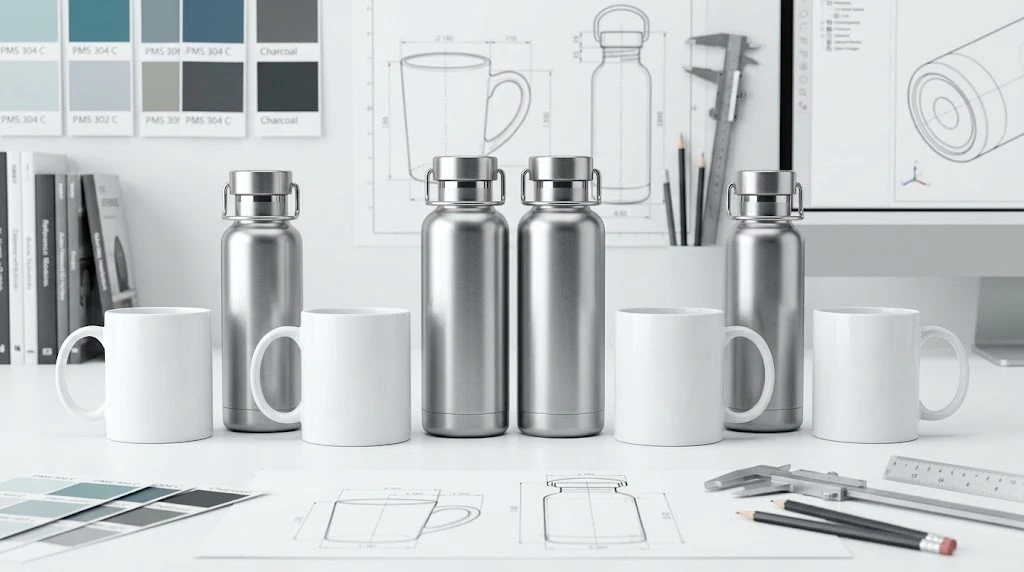
One-Piece vs. Two-Piece Bottle Construction
Which Build Is Right for Your Program?
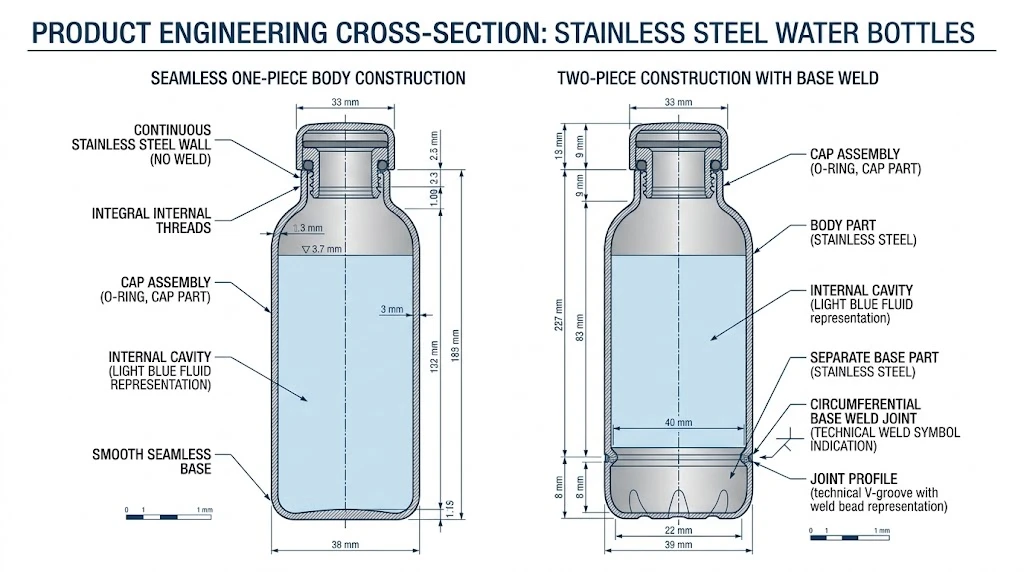
Table of Contents
- 1. One-Piece (Seamless) Construction: Process, Pros & Cons
- 2. Two-Piece (Welded) Construction: Process, Pros & Cons
- 3. Quality Comparison: Leak Rate, Weld Integrity & Drop Durability
- 4. Cost & MOQ Comparison: When Each Structure Wins
- 5. Which Construction Should Your Brand Choose? A Decision Guide
- 6. Partner With Mofecup for Optimal Bottle Construction
1. One-Piece (Seamless) Construction: Process, Pros & Cons
The structural design of a water bottle starts with a fundamental manufacturing decision: whether to form the body as a single continuous piece or to join two separately formed components. One-piece construction — also called seamless or monobloc — forms the entire bottle body, including the tapered shoulder and base, from a single flat metal disc or slug through a series of deep-drawing operations. The process typically involves 3–7 progressive draw stages on a mechanical or hydraulic press, with intermediate annealing steps to relieve work hardening[1]. For stainless steel bottles, the starting blank is a laser-cut circle of 304 or 316 sheet, typically 0.4–0.6 mm thick; each draw stage reduces the diameter and increases the height until the final bottle geometry is achieved.
The advantages of a seamless body
The primary advantage is the complete absence of welds or joints. Without a weld seam, there is no risk of weld porosity, incomplete fusion, or heat-affected zone (HAZ) degradation — all potential leak paths in two-piece bottles. The seamless body also offers superior hygiene: no crevices or micro-gaps where bacteria can accumulate, which is why one-piece bottles are the preferred choice for medical, laboratory and premium food-grade applications. Wall thickness uniformity is excellent — typically varying by less than ±0.05 mm across the entire body — which translates to consistent insulation performance and structural strength.
The trade-offs: tooling cost and complexity
The progressive draw dies required for seamless forming are expensive to machine — typically $8,000–$25,000 per bottle size — and the deep-draw process needs a larger press with a longer stroke. Setup changeover times between sizes can run 4–8 hours. These factors make one-piece construction most suitable for high-volume programs (3,000+ units per size) where the tooling investment can be amortized across larger production runs.
2. Two-Piece (Welded) Construction: Process, Pros & Cons
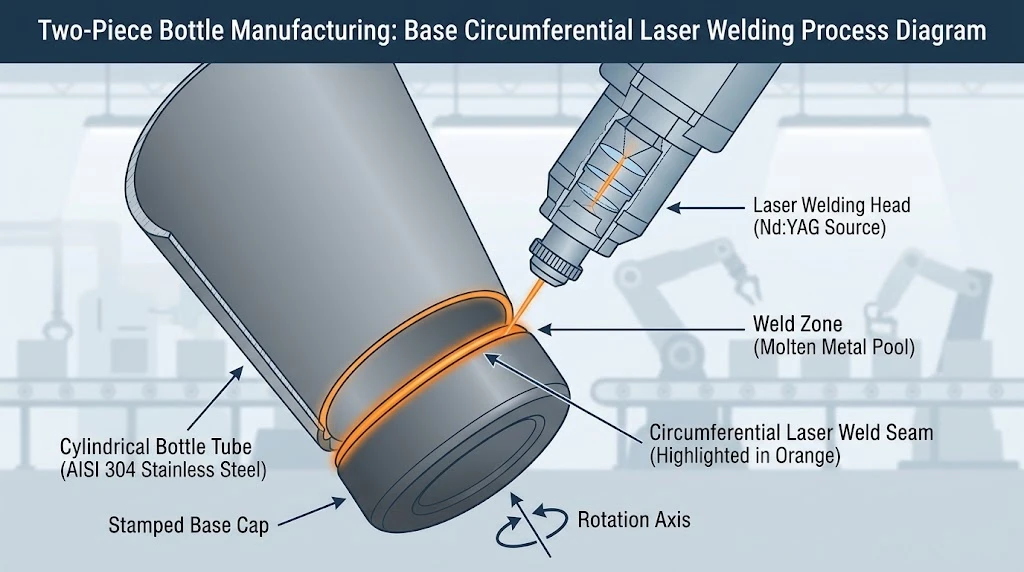
Two-piece construction separates the bottle into two components: a cylindrical body tube and a separately stamped base cap. The body tube is formed by roll-forming or draw-bending a flat sheet into a cylinder, then longitudinally welded (laser or TIG), or drawn from a shallower cup. The base cap is stamped from sheet metal and joined to the body tube via a circumferential weld — usually micro-TIG, laser or induction welding. After welding, the base area is often ground or polished to minimize visual evidence of the joint.
The economic case for two-piece
For programs with moderate volumes or multiple size variants, the economics are compelling. Tooling costs are roughly half those of one-piece construction because the individual forming dies are simpler and smaller. The stamping die for the base cap can often be shared across multiple bottle heights within the same diameter, further reducing tooling investment for product families. Tooling lead time is typically 3–5 weeks versus 6–10 weeks for one-piece progressive dies. Two-piece also enables smaller MOQs — 500 units per size versus 1,000–3,000 for one-piece — making it accessible for pilot programs, promotional campaigns and regional launches.
The quality risk: the circumferential base weld
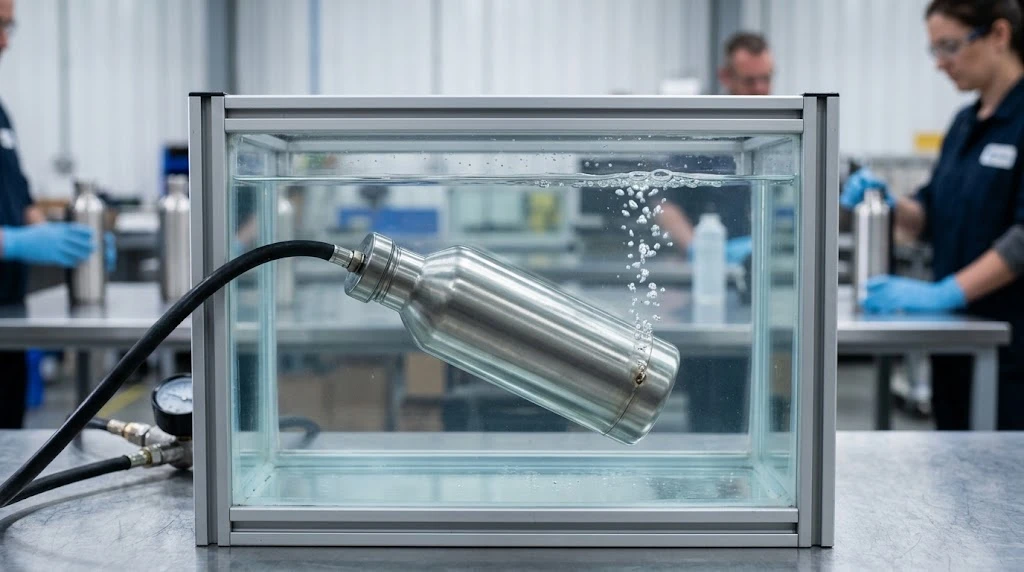
The quality risk centers on the base weld. Common weld defects include lack of fusion (typically 0.2–0.8% of units), porosity voids (0.1–0.5%), and HAZ thinning that can reduce local wall thickness by 15–25%. Reputable manufacturers run 100% air-pressure leak testing on every two-piece bottle — typically 10–15 PSI submerged in water — to detect and reject units with weld defects. One caveat for specifiers: the post-weld polishing step, while improving aesthetics, removes an additional 0.05–0.10 mm of wall thickness at the weld zone, so the weld design must account for this material removal.
3. Quality Comparison: Leak Rate, Weld Integrity & Drop Durability
Factory leak test data from production runs of 50,000+ units for each construction type reveals measurable quality differences:
- Leak rate: One-piece bottles consistently achieve defect rates below 0.1% at 15 PSI air pressure, with most production runs yielding zero rejects. Two-piece bottles at the same test pressure show reject rates of 0.3–1.5%, with the higher figure associated with thinner-gauge materials (≤0.4 mm) or higher production speeds.
- Drop durability (ASTM D5276): In drop testing from 1.5 m onto a concrete surface, two-piece bottles fail at the weld junction in approximately 85% of mechanical failure cases, while one-piece bottles fail by denting or body deformation without leakage[2].
For B2B buyers specifying products for outdoor or active use where drops are expected, one-piece construction provides a meaningful durability advantage. For promotional or short-lifecycle programs where the bottle will be used gently, the practical risk difference is smaller.
4. Cost & MOQ Comparison: When Each Structure Wins
At a 10,000-unit order for a 500 mL 304 stainless steel bottle with a single-wall body, one-piece construction typically prices at $3.50–$6.00 per unit and two-piece at $2.50–$4.50 per unit — a saving of $1.00–$1.50 per unit, or 25–30%. At 5,000 units the gap narrows to $0.70–$1.00 per unit. Below 2,000 units, two-piece is often the only economically viable option unless the program can absorb the tooling cost.
Vacuum-insulated bottles are the exception: both construction methods incorporate a separate inner liner and outer shell, so the insulation layer is always two pieces regardless of body construction. As a result, the per-unit cost differential narrows to 10–15% for double-wall products — structure choice matters less for thermos programs than for single-wall bottles[3]. See our double-wall and triple-wall vacuum insulation guide for the full breakdown.
5. Which Construction Should Your Brand Choose? A Decision Guide
The table below summarizes the trade-offs that matter most when specifying a bottle program[1]:
| Parameter | One-Piece | Two-Piece | Procurement Impact |
|---|---|---|---|
| Forming process | Deep drawing / impact extrusion from a single metal blank | Body tube + base cap formed separately, then welded | One-piece needs larger press capacity and deeper dies |
| Seam / weld | No weld — seamless body and base | Circumferential weld joins base to body tube | Weld = potential failure point and leak path |
| Tooling cost | $8,000–$25,000 per size | $4,000–$12,000 per size | Two-piece reduces tooling investment by 40–50% |
| Minimum order quantity | 1,000–3,000 units per size | 500–1,500 units per size | Two-piece is more accessible for small to medium programs |
| Leak rate (factory test) | <0.1% at 15 PSI air test | 0.3–1.5% at 15 PSI air test | One-piece offers inherently lower leak risk |
| Wall uniformity | ±0.05 mm thickness variation | ±0.10 mm (body) + weld bead zone | One-piece has more consistent wall thickness |
| Visual / aesthetic | Seamless, no visible joint | Visible base seam (may be hidden with a base cap) | One-piece looks more premium at point of sale |
| Per-unit cost (10K vol.) | $3.50–$6.00 (304 SS, 500 mL) | $2.50–$4.50 (304 SS, 500 mL) | Two-piece saves $1.00–$1.50 per unit at scale |
Quick selection rules
- Order volume ≥3,000 units per size, premium brand image, or outdoor/drop-heavy use → prioritize one-piece. The tooling pays for itself and the seamless story sells.
- Medium volumes, multiple size variants, budget-sensitive, or first pilot run → two-piece is the safer economic bet.
- Vacuum-insulated programs → the cost gap narrows to 10–15%, so decide mainly on brand positioning and MOQ.
- Whatever you choose → require 100% air-pressure leak test reports and ASTM D5276 drop test data from the factory before placing the order.
Mofecup operates both one-piece deep-draw presses and two-piece automated welding lines, so we can recommend the optimal construction based on your volume, quality requirements and budget — with tooling amortization and per-unit pricing for both options. Send us your target volume and specifications: Request a custom drinkware quote →
6. Partner With Mofecup for Optimal Bottle Construction
Mofecup is a drinkware supplier offering end-to-end OEM/ODM services with both construction capabilities in-house:
- One-piece deep-draw presses and two-piece automated welding lines — we recommend the right structure, not the one we happen to run.
- 100% air-pressure leak testing on every production bottle, plus weld inspection via eddy current and dimensional gauging.
- Material certificates issued for the material batch, as industry practice requires.
- Flexible MOQs and small-batch customization for brand launches.
New to the sourcing process? Start with our custom water bottle manufacturing guide, or browse more build-related comparisons in the structural design category.
Footnotes & References
[1] Industry data on progressive deep-drawing tooling costs, draw stages and setup times, compiled from drinkware manufacturing practice. Mofecup engineering department.
[2] ASTM International. ASTM D5276-19 — Standard Test Method for Drop Test of Loaded Containers by Free Fall. astm.org
[3] Factory leak test data from production runs of 50,000+ units per construction type; cost curves based on 304 stainless steel single-wall and double-wall programs. Exact pricing depends on specifications — request a quote for your program.