
Double-Wall vs. Triple-Wall Vacuum Insulation
Engineering Comparison for Custom Bottles
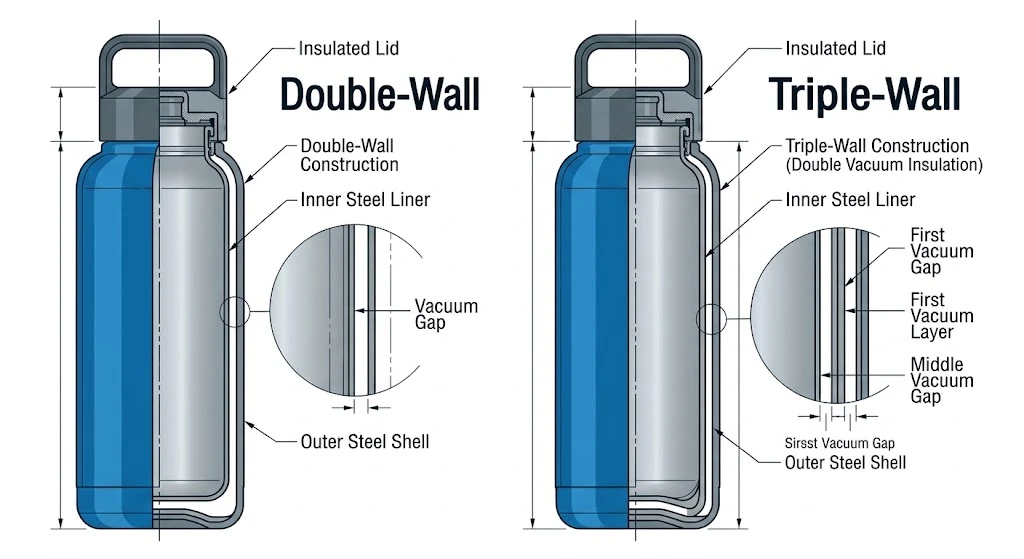
Table of Contents
- 1. Thermal Performance: Measured Heat Retention Differences
- 2. Manufacturing: Vacuum Pumping & Getter Technology
- 3. Weight & User Experience Tradeoffs
- 4. Material Selection: 304 vs 316
- 5. Sourcing Recommendations by Use Case
- 6. Quality Control: Verifying Vacuum Integrity
- 7. Partner With Mofecup
1. Thermal Performance: Measured Heat Retention Differences
Vacuum insulation is the dominant thermal retention technology in premium custom water bottles. The principle is straightforward: two (or three) stainless steel walls create an evacuated cavity that virtually eliminates conductive and convective heat transfer. But the choice between double-wall and triple-wall designs involves tradeoffs in thermal performance, empty weight, manufacturing cost, and internal diameter constraints that directly affect your product’s market positioning[1].
Triple-wall insulation adds a third layer and a second evacuated cavity, theoretically reducing heat loss further. However, the incremental gain over a well-executed double-wall design is smaller than marketing often suggests. Thermal performance depends heavily on vacuum quality, getter efficiency and reflective coatings — not just the number of walls[2].
| Metric | Double-Wall (Standard) | Double-Wall (Copper-Backed) | Triple-Wall (Premium) |
|---|---|---|---|
| Evacuated cavities | 1 | 1 | 2 |
| Wall thickness | 4–6 mm | 4–6 mm | 7–10 mm |
| Hot retention (95→60 °C) | 6–8 hours | 8–10 hours | 8–12 hours |
| Cold retention (0→10 °C) | 12–18 hours | 16–22 hours | 18–24 hours |
| Empty weight (500 ml) | 240–290 g | 255–305 g | 310–380 g |
| Internal neck diameter | 45–55 mm | 45–55 mm | 35–42 mm (restricted) |
| OEM cost premium vs baseline | Baseline | +10–15% | +35–55% |
Triple-wall delivers roughly 30–40% longer heat retention than standard double-wall, but a double-wall design with copper-backed vacuum pumping achieves ~90% of triple-wall thermal performance at ~65% of the cost. The copper coating reflects radiant heat back into the liquid — the dominant heat transfer mode at high temperatures.
2. Manufacturing: Vacuum Pumping & Getter Technology
Both double-wall and triple-wall bottles rely on the same core manufacturing steps, but triple-wall adds an intermediate wall-forming station that increases tooling investment and cycle time:
- Deep drawing: Inner and outer shells formed from 304 or 316 sheets (0.5–0.8 mm). Triple-wall demands a deeper draw ratio (2.5:1 vs 2.0:1).
- Neck welding: Laser or TIG welding; triple-wall needs two separate weld seams.
- Air evacuation: High-vacuum pumping (10⁻³–10⁻⁵ torr) at 400–500 °C for 45–120 min. Triple-wall needs 1.5–2× longer pump-down.
- Getter activation: Barium-based getter flashed after tip-off; triple-wall needs 30–50% larger active surface.
- Copper base (optional): 0.1–0.3 µm copper coating via PVD captures the majority of radiant heat loss reduction — the key upgrade for premium double-wall.
Triple-wall requires an additional deep-drawing die set and a second welding station, increasing tooling investment by roughly $25,000–40,000 per SKU. For small-batch OEM runs under 5,000 units, the tooling amortization may be prohibitive[3].
3. Weight & User Experience Tradeoffs
End-user experience differs substantially between the two architectures, affecting product return rates and customer satisfaction:
- Double-wall: A 500 ml bottle weighs ~260 g — comfortable for commuting and gym bags. The wider neck (50 mm) accommodates standard ice cubes and easy cleaning.
- Triple-wall: Same capacity weighs ~350 g — 35% heavier. The narrower neck (~38 mm) restricts ice cubes and makes hand cleaning difficult.
- Sweet spot: Copper-backed double-wall hits ~270 g with 9–10 hours hot retention.
If your target demographic values light carry weight and easy cleaning, double-wall is the correct specification. If extreme thermal endurance (12+ hours for hot beverages) is the primary purchase driver, triple-wall justifies its tradeoffs[4].
4. Material Selection: 304 vs 316
Both wall configurations are compatible with the two dominant food-grade stainless steel alloys:
| Property | 304 Stainless | 316 Stainless |
|---|---|---|
| Corrosion resistance (salt spray) | 200+ hours | 1,000+ hours ✅ |
| Chloride pitting (PREN) | 19 (moderate) | ≥24 (excellent) |
| Deep drawability | Excellent — 2.0:1 ratio | Good — 1.8:1 (more springback) |
| Material cost premium | Baseline | +20–30% |
For most B2B programs, 304 provides adequate performance at the lowest cost. Specify 316 only for harsh environments (saltwater, acidic beverages, aggressive commercial dishwasher detergents). Note that 316’s superior corrosion resistance comes with slightly reduced deep-draw formability, which can increase scrap rates in triple-wall production[5]. For a full comparison of steel grades, see our guide to 201 vs 304 vs 316 stainless steel.
5. Sourcing Recommendations by Use Case
| Use case | Recommended architecture | Why |
|---|---|---|
| Corporate gifts / promotional | Double-wall copper-backed | Best balance of performance, cost ($6–10/unit) and weight |
| Outdoor / sports (hiking, climbing) | Standard double-wall, wide mouth (55 mm) | Light weight, easy hydration, filter compatibility |
| Premium retail / hospitality | Copper-backed double-wall or triple-wall | Triple-wall suits stationary table service |
| Kids / school | Standard double-wall only | Lighter, cheaper ($5–8/unit), wider mouth for cleaning |
| “12+ hours hot” marketing claim | Triple-wall or copper-backed double-wall | Standard double-wall cannot reliably exceed 8h; need verified test data |
6. Quality Control: Verifying Vacuum Integrity
Regardless of wall count, vacuum integrity is the single most important quality attribute. A bottle with degraded vacuum performs no better than a single-wall container. Insist on these QC checks from your supplier:
- Thermal testing: 100% of bottles subjected to 60 °C hot fill + 10-min IR camera scan; pass/fail ≤ 2 °C surface variation.
- Vacuum gauge sampling: 1–3% per batch with Penning gauge; reject above 1×10⁻² torr and quarantine the preceding production hour.
- Accelerated aging: 10 bottles/batch through 30 hot/cold cycles (95→0 °C); pass if no bottle loses >10% retention.
- Getter inspection: Visual check of the getter flash (silver mirror) on 100% of bottles; cloudy/missing getter = immediate rejection.
Specifying insulated bottles and unsure between double-wall and triple-wall?
Mofecup produces both double-wall and triple-wall configurations across 250+ existing mold designs, including copper-backed variants. Our engineering team can share thermal performance test reports for each architecture and help you match the right spec to your market. Request a quote →
7. Partner With Mofecup
Mofecup is a drinkware supplier offering end-to-end OEM/ODM services:
- Double-wall and triple-wall configurations across 250+ existing mold designs, including copper-backed variants.
- Thermal performance test reports available for each architecture; vacuum failure rate < 0.3% verified by monthly third-party audits.
- Custom branding: laser engraving, screen printing, PVD coating and full-color options.
- Flexible MOQs and small-batch customization for brand launches.
Related reading: titanium vs stainless steel bottles and copper vs stainless vs ceramic liners.
Footnotes & References
[1] British Stainless Steel Association (BSSA). Stainless Steel Grade Datasheets. bssa.org.uk
[2] U.S. Department of Energy. Vacuum Insulation Principles — heat transfer fundamentals. Technical reference. energy.gov
[3] ASTM International. ASTM A240/A240M — Stainless steel plate, sheet and strip specification. astm.org
[4] Engineering Toolbox. Thermal Conductivity of Metals — steel, copper, titanium. engineeringtoolbox.com
[5] U.S. Food & Drug Administration (FDA). Food Contact Substances (FCS) — regulatory overview. fda.gov