Ceramic Coating vs. PVD Coating
Choosing the Right Surface Finish
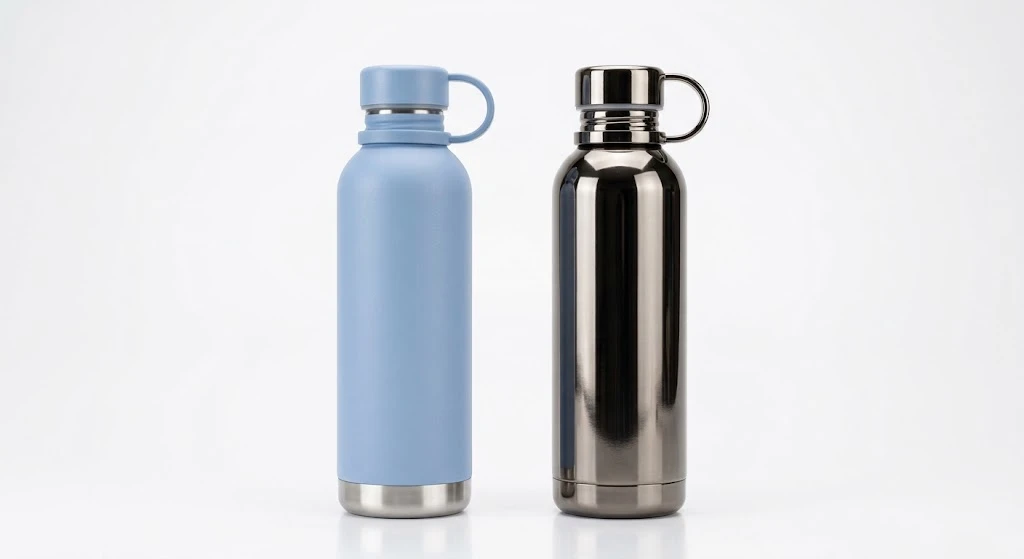
Table of Contents
- 1. What Is Ceramic Coating for Drinkware?
- 2. What Is PVD Coating for Drinkware?
- 3. Performance Comparison
- 4. When to Choose Ceramic Coating
- 5. When to Choose PVD Coating
- 6. Decision Matrix for Your Brand
- 7. Partner With Mofecup
1. What Is Ceramic Coating for Drinkware?
Ceramic coating (sol-gel ceramic finish) is a liquid-based coating applied to the metal substrate and cured at high temperatures to form a hard, glass-like surface layer. Despite its name, it is not pure ceramic but a hybrid organic-inorganic polymer matrix reinforced with ceramic nanoparticles (silicon dioxide SiO₂, aluminum oxide Al₂O₃)[1].
Application process
- Surface preparation: Cleaned, degreased, chemically etched for adhesion.
- Spray application: Precision spray in a dust-controlled environment.
- Flash-off: Solvents evaporate 5–15 min at room temperature.
- Curing: Convection oven at 150–200°C for 20–45 min.
- Inspection: Film thickness (20–50 microns), hardness, color uniformity measured.
2. What Is PVD Coating for Drinkware?
PVD (Physical Vapor Deposition) is a vacuum-based thin-film technology. A solid target material is vaporized in a vacuum chamber and deposited as a thin film onto the bottle surface — resulting in an exceptionally hard, dense coating (typically 1–5 microns) that bonds at the atomic level[2].
Application process
- Vacuum chamber loading: Bottles mounted on rotating fixtures.
- Vacuum creation: Chamber evacuated to 10⁻⁵–10⁻⁶ Torr.
- Plasma cleaning: Argon plasma cleans at the atomic level.
- Deposition: Target vaporized by electron beam, magnetron sputtering or cathodic arc.
- Cooling & inspection: Chamber vented, bottles inspected.
3. Performance Comparison
| Property | Ceramic Coating | PVD Coating |
|---|---|---|
| Pencil hardness | 6H–9H | 8H–9H+ (harder) ✅ |
| Thickness | 20–50 microns | 1–5 microns (ultra-thin) ✅ |
| Corrosion resistance | Good (requires sealing) | Excellent (pinhole-free) ✅ |
| UV stability | Good (may yellow over time) | Excellent (no degradation) ✅ |
| Color range | Any RAL/Pantone color ✅ | Metallic tones (gold, bronze, gunmetal, black, silver, rose gold, blue) |
| Gloss options | Matte, satin, gloss ✅ | Typically satin |
| Food safety | ✅ FDA-compliant when fully cured | ✅ Inert and non-reactive |
| Relative cost per unit | $$ (30–50% cheaper) ✅ | $$$ (premium) |
4. When to Choose Ceramic Coating
- Brand color precision: Can be matched to Pantone/RAL — ideal for brand identity.
- Gloss control: Widest range, from ultra-matte (5 GU) to high-gloss (90+ GU).
- Budget: 30–50% less expensive than PVD for equivalent coverage.
- Low MOQ: Feasible from 500 units due to lower setup costs.
- Textured finishes: Soft-touch and pebble finishes possible.
5. When to Choose PVD Coating
- Maximum durability: Harder and more wear-resistant than any liquid-applied coating.
- Harsh environments: Outdoor, industrial, extreme sports.
- Premium metallic look: Natural metallic finishes ceramic cannot replicate.
- Ultra-thin tolerances: 1–5 microns doesn’t affect threads, snap-fits or deboss features.
- Long-term brand value: Lasts the product lifetime with minimal visual degradation.
6. Decision Matrix for Your Brand
| Brand scenario | Recommended coating | Why |
|---|---|---|
| Branded corporate program (specific brand colors) | Ceramic | Pantone/RAL color matching + lower cost |
| Premium metallic / luxury positioning | PVD | Metallic aesthetic + lifetime durability |
| Outdoor / sports / harsh environments | PVD | Superior corrosion + scratch resistance |
| Small-batch launch (MOQ 500-2,000) | Ceramic | Lower setup cost, feasible MOQ |
| High-volume, cost-sensitive line | Ceramic | 30–50% cheaper at scale |
Mofecup offers both ceramic and PVD coating capabilities. Request samples of both technologies to compare color, gloss and durability on your actual product. Request a quote →
7. Partner With Mofecup
Mofecup is a drinkware supplier offering end-to-end OEM/ODM services:
- Both ceramic and PVD coating capabilities with sample support.
- Custom branding: laser engraving, screen printing, PVD coating and full-color options.
- Export compliance documentation (CE, FDA and other target-market certifications as required).
- Flexible MOQs and small-batch customization for brand launches.
Related reading: 201 vs 304 vs 316 stainless steel and laser engraving vs screen printing.